
For wireless links and coverage projects, the parabolic dish has the highest gain: BBT dishes span 17–34 dBi. Grid and mesh dishes top out at 29 dBi, flat panels at 26 dBi, horn, sector and Yagi antennas around 17–20 dBi, and high-gain omnis around 15 dBi. Higher gain means a narrower beam, so choose by link direction, band and site, not dBi alone.
Last updated: November 2026
Which Antenna Type Has the Highest Gain?
The parabolic dish antenna has the highest gain of any common antenna type, because its solid reflector gathers energy over a wide aperture and focuses it into the narrowest beam. In the BBT range, the 1.2 m BBT-5259PM34V12 dish reaches 34 dBi with a 3° beam.
The other high-gain antenna types follow in a clear order. The table below compares all eight on the gain, beamwidth, bands and size that BBT builds into each type, so every figure comes from a real product.
| Antenna type | BBT gain range | Horizontal beamwidth | Bands covered by BBT | Size and mounting | Typical use | Where to start |
|---|---|---|---|---|---|---|
| Parabolic dish (solid) | 17–34 dBi | 3° | 2.4–5.95 GHz | Φ1200 mm reflector on a φ30–60 mm pole | Long-distance point-to-point backhaul | 2.4–6.4 GHz dish antennas |
| Grid and mesh parabolic | 10–29 dBi | 6° | 824 MHz–5.85 GHz (wideband model: 600–6000 MHz) | 600×900 mm open grid with low wind load | Point-to-point links on windy sites; sub-1 GHz and cellular links | 5G grid and mesh antennas |
| Flat panel | 14–26 dBi | 6° | 2.4–5.85 GHz | 450×450 mm flat radome | Short building-to-building links and fixed wireless terminals | Flat panel antennas |
| Horn | 15.5–20.5 dBi | 15–20° | 4.9–7.125 GHz | Φ230×350 mm, 0.75 kg | WISP point-to-multipoint access on busy towers | Horn antennas |
| Sector | 8–20 dBi (most models 14–17 dBi) | 65° (vertical 5–7°) | 698 MHz–5.9 GHz | 895×280×80 mm column on a φ30–60 mm pole | Base station and WISP sector coverage | Sector antennas MIMO sector antennas |
| Yagi | 8–17 dBi | 25° | 380 MHz–2.17 GHz | 1809 mm boom on a φ30–60 mm pole | Sub-1 GHz links for LoRa, telemetry and remote sites | VHF/UHF Yagi antennas Cellular Yagi antennas |
| Log-periodic | 9–11 dBi | 50–65° | 617–6000 MHz | 445×210×64 mm, 0.8 kg | Multiband donor and site antennas | Log-periodic antennas |
| High-gain omnidirectional | 10–15 dBi | 360° (vertical 5°) | 806 MHz–5.85 GHz | 1.35–1.45 m vertical radome | Hub sites serving users in every direction | High-gain omni antennas Cellular omni antennas |
Gain ranges are taken from BBT product datasheets, November 2026. Beamwidth and size refer to the highest-gain model of each type.
Gain rises with two things: aperture size and frequency. A reflector that spans many wavelengths focuses energy tightly, and the same reflector spans more wavelengths as the frequency goes up. Three BBT models with 1.2 m reflectors show the effect: the BBT-0809PW18V12 grid delivers 18 dBi at 870–960 MHz, the BBT-2425PM28V12 dish 28 dBi at 2400–2500 MHz, and the BBT-5259PM34V12 dish 34 dBi at 5200–5900 MHz.
That is why sub-1 GHz projects usually turn to grid or Yagi antennas when they need gain. At 900 MHz, a 1.2 m reflector gives 18 dBi, and every extra dB needs a bigger reflector that catches more wind. An open grid lets that wind through, and a Yagi reaches 17 dBi at 902–928 MHz on a 1809 mm boom that mounts on a standard pole.
BBT High-Gain Antennas by Type
Four BBT models show what the top of each range looks like: the highest-gain solid dish, a dual-band 5G MIMO mesh dish for cellular links, a horn that spans 4.9–7.125 GHz for WISP towers, and a 17 dBi Yagi for the 902–928 MHz band.

34 dBi Parabolic Dish Antenna
BBT-5259PM34V12
5200–5900 MHz · 34 dBi
3° / 3° beam · vertical polarization
F/B ≥38 dB · VSWR ≤2 · 100 W
N-Female · Φ1200 mm · 60 m/s wind rating
View Detail
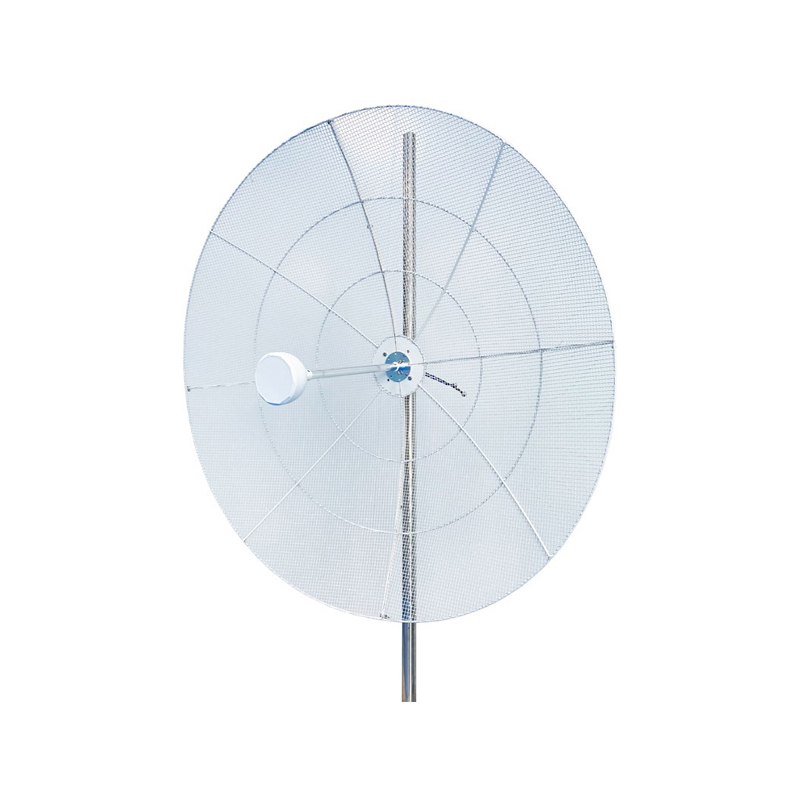
27 dBi 5G MIMO Mesh Parabolic Antenna
BBT-1742PW27D12-N2
1710–2690 / 3300–4200 MHz · 27±1 dBi
6° / 5° beam (±2°) · ±45° dual-pol
F/B ≥30 dB · isolation ≥25 dB · 100 W
2 × N-Female · Φ1200 mm iron mesh · 60 m/s
View Detail

20.5 dBi 4.9–7.125 GHz Horn Antenna
BBT-4971HO20R-N2
4900–5400 / 5400–6400 / 6400–7125 MHz
19 / 20 / 20.5 dBi (±0.5) · H-beam 20° / 17° / 15°
V/H dual-pol · F/B ≥25 dB · 100 W
2 × N-Female · Φ230 × 350 mm · 0.75 kg
View Detail

17 dBi 902–928 MHz Yagi Antenna
BBT-09YI17V17
902–928 MHz · 17 dBi
25° / 25° beam · vertical polarization
VSWR ≤1.5 · F/B ≥20 dB · 100 W
RP-SMA Male · 1809 × 172 × 68 mm · 60 m/s
View Detail
Need a different size, band or port count? See the 29 dBi grid antenna (BBT-5158PW29V06) for 5150–5850 MHz, the wideband grid antenna (BBT-0660PW1321VH09) for 600–6000 MHz, the 0.6 m 5G MIMO mesh parabolic antenna (BBT-1742PW2022D06-N2) at 20 / 22 dBi, the 26 dBi flat panel antenna (BBT-5158PA26V006), the 2.4 / 5 GHz MIMO sector antenna (BBT-2459PA1720D065-N4) at 17 / 20 dBi, the 2.4 / 5 GHz high-gain omni antenna (BBT-2458FG1215V) at 12 / 15 dBi and the wideband log-periodic antenna (BBT-0660LP1011V065) for 698–6000 MHz.
What Makes an Antenna “High Gain”?
A high-gain antenna concentrates its energy into a narrow beam aimed where the signal needs to go. The antenna adds no power of its own. It takes energy away from directions you do not need and puts it into the main beam.
Gain is quoted in dBi, measured against an ideal isotropic radiator that sends energy equally in every direction (0 dBi). A half-wave dipole measures 2.15 dBi. Every 3 dB of extra gain doubles the power in the main direction, and every 10 dB multiplies it by ten.
No industry-wide threshold defines “high gain”, so the answer depends on the antenna type. For an omnidirectional antenna, 10–15 dBi is already high. Directional types go much higher: the top models in the BBT range reach 17 dBi for a Yagi and 34 dBi for a dish.
The beam shows where the gain comes from. BBT's 12 / 15 dBi dual-band omni keeps 360° horizontal coverage and squeezes its vertical beam to 5° in the 15 dBi band. The 34 dBi dish narrows both planes to 3°. For the theory behind these numbers, see our guide to antenna gain vs directivity, and for the units on a datasheet, our explainer on dB, dBi and dBm.
Wider coverageHigher gain
High-Gain Antenna Types Explained
Each type builds gain in a different way, and that method sets its beam shape, size and best project fit. The eight types below run roughly from the highest gain to the widest coverage.
Parabolic Dish Antennas
A solid parabolic reflector bounces the energy from a feed at its focal point into a pencil-thin beam, and its large surface makes that beam the narrowest of any type. BBT dish antennas deliver 17–34 dBi across 2.4–5.95 GHz, with reflectors from Φ450 mm to Φ1200 mm and beamwidths from 20° down to 3°. Single-polarized and dual-polarized versions are both available, and the dual-polarized models (±45° or horizontal/vertical) carry two N-type ports for MIMO radios. A dish is the first choice for long point-to-point backhaul, where every dB of link margin counts. The cost is precise alignment and a solid surface that takes the full force of the wind. Browse our 2.4–6.4 GHz dish antennas, and see our guide to point-to-point antennas for link planning.
Grid and Mesh Parabolic Antennas
Grid and mesh antennas keep the parabolic shape but use an open reflector, so wind passes through it instead of loading the mount. BBT grid and mesh models deliver 10–29 dBi from 824 MHz to 5.85 GHz, plus a wideband grid that covers 600–6000 MHz at 13 / 21 / 20 / 19 dBi. The open design lets BBT build high-gain parabolic models for sub-1 GHz and 1.7–1.9 GHz cellular bands. The 5 GHz BBT-5158PW29V06 reaches 29 dBi from a 600×900 mm reflector, and for 5G and LTE links, the 1.2 m 5G MIMO mesh parabolic antenna delivers 27 dBi across 1710–2690 and 3300–4200 MHz with ±45° dual polarization and two N-type ports. Choose a grid for windy, exposed towers and for high-gain cellular links to a distant base station. Compare models in our 5G grid and mesh antennas range.
Flat Panel Antennas
A flat panel antenna builds gain from an array of radiating elements behind a flat radome, so it stays compact and mounts easily on a wall or short pole. BBT flat panels deliver 14–26 dBi across 2.4–5.85 GHz. The 26 dBi BBT-5158PA26V006 measures 450×450 mm with a 6° / 5° beam, while 14–18 dBi models with 30° to 18° beams come as small as 190×190 mm. Panels suit short building-to-building links, fixed wireless terminals and sites where a low profile matters. See panel antenna uses for typical deployments, or browse our flat panel antennas.
Horn Antennas
A horn antenna flares a waveguide into a wide mouth, which produces a symmetrical beam with low side lobes. BBT horn antennas deliver 15.5–20.5 dBi across 4.9–7.125 GHz, with beams from 40° down to 15° and weights of 0.45–0.75 kg. Low side lobes keep radios on a crowded tower from interfering with each other, so WISPs use horns for point-to-multipoint access where several access points share one mast. The 20.5 dBi BBT-4971HO20R-N2 covers 4900–7125 MHz in one unit with vertical and horizontal polarization. Browse our horn antennas, compare 20° vs 30° WISP horns, and see horn vs dish for longer links.
Sector Antennas
A sector antenna stacks radiating elements in a tall column, which narrows the vertical beam while keeping a wide horizontal one, so a few units side by side cover a full 360° site. BBT sector antennas reach up to 20 dBi, with most models at 14–17 dBi, and come in 65°, 90° and 120° horizontal beamwidths across 698 MHz–5.9 GHz. The vertical beam can be as tight as 5°, which carries signal far toward the horizon but needs correct downtilt to serve users near the tower. Base stations and WISP access sites use sectors to split coverage and capacity by zone. MIMO models such as the 2.4 / 5 GHz BBT-2459PA1720D065-N4 carry four N-type ports. Browse our sector antennas and MIMO sector antennas, or read our sector antenna guide.
Yagi Antennas
A Yagi antenna lines up a driven element, a reflector and a row of directors along a boom. More directors mean a longer boom, more gain and a narrower beam. BBT Yagi antennas deliver 8–17 dBi from 380 MHz to 2.17 GHz. Below 1 GHz, a Yagi reaches high gain in a far smaller package than a dish of similar gain: the 17 dBi BBT-09YI17V17 for 902–928 MHz is 1809 mm long and fits a standard φ30–60 mm pole. Yagis suit LoRa links, SCADA telemetry and remote sites aimed at one distant station. Each model covers a narrow band, so match it to your exact frequencies. Browse our VHF/UHF Yagi antennas and cellular Yagi antennas, and see Yagi vs omni for how the two share a network.
Log-Periodic Antennas
A log-periodic antenna uses a row of dipoles that grow longer along the boom, so a different group of elements does the work at each frequency. It trades some gain for bandwidth: BBT log-periodic antennas cover 617–6000 MHz at 9–11 dBi. The BBT-0660LP1011V065 serves 698–960, 1710–2700 and 3300–6000 MHz at 10 / 11 / 11 dBi from one 445×210×64 mm housing. Choose a log-periodic as a multiband donor antenna, or wherever one antenna must cover several operator bands at a site. Browse our log-periodic antennas and compare LPDA vs Yagi.
High-Gain Omnidirectional Antennas
A high-gain omni stacks radiating elements in a vertical array, which flattens its coverage into a thin disc around the horizon while keeping 360° horizontal coverage. BBT high-gain omni antennas deliver 10–15 dBi from 806 MHz to 5.85 GHz. More gain makes the disc thinner: the 15 dBi band of the BBT-2458FG1215V has a 5° vertical beam, so users close to the base of a tall mast can fall below it. Length grows as frequency falls, and BBT's 12 dBi omnis run from 0.8 m at 5.8 GHz to 2.8 m at 806–960 MHz. Use high-gain omnis at hub sites, LoRa gateways and WISP base stations that serve users all around. Browse our high-gain omni antennas and cellular omni antennas, and read omni vs directional before you decide.
Is Higher Gain Always Better?
Higher gain is better only in the directions your signal needs to reach. Every dB comes from narrowing the beam somewhere, and the choice between a high-gain and a low-gain antenna turns on these trade-offs:
- Alignment: a 3° dish beam leaves little margin for error. Tower sway, loose brackets and a twisting pole can pull the link off target, so use rigid mounts and align both ends carefully.
- Coverage close to the site: high-gain omni and sector antennas have narrow vertical beams, so areas near or below the antenna can see weak signal. Downtilt, or a lower-gain model, fills the gap.
- Size and wind load: a 1.2 m dish or a 1.8 m Yagi needs a strong mount. Check the rated wind velocity (60 m/s on most BBT models) and the pole diameter the bracket accepts.
- Bandwidth: a Yagi delivers high gain over a narrow band, while a log-periodic covers 617–6000 MHz at a lower 9–11 dBi.
- Power limits: many countries and regions cap EIRP, and in some unlicensed bands, fitting a higher-gain antenna means turning the radio's transmit power down. Local regulations set the limit.
- Obstructions: gain cannot push a signal through hills, buildings or dense trees. The link still needs line of sight and a clear path.
The same trade-off answers the familiar 3 dBi vs 5 dBi question. The 5 dBi antenna reaches further in its main direction and covers less above and below it, so the better choice depends on where your users or the far end of the link sit.
How to Choose a High-Gain Antenna Type for Your Project
Start with the project: link direction, distance, band and site conditions narrow the choice to one or two types, and the gain you need then picks the model.
| Project | Recommended type | BBT gain range | Why it fits |
|---|---|---|---|
| Long-distance point-to-point backhaul | Parabolic dish; grid on windy or exposed sites | 17–34 dBi (dish); up to 29 dBi (grid) | The narrowest beam and the most link margin; a grid cuts wind load |
| Short link between buildings | Flat panel or small-diameter dish | 14–26 dBi (panel) | Compact, quick to mount and strong enough for short hops |
| WISP point-to-multipoint access | Horn on busy towers; sector for wide-area coverage | 15.5–20.5 dBi (horn); up to 20 dBi (sector) | Horns keep side lobes low where many radios share a mast; a sector covers a wide zone from one antenna |
| Cellular and private LTE / 5G sector coverage | Sector, with multi-port MIMO models | 14–17 dBi typical, up to 20 dBi | 65°, 90° or 120° zones with a narrow vertical beam; MIMO ports for 4G and 5G radios |
| Remote site linking to a distant base station | 5G MIMO mesh parabolic or grid; Yagi below 1 GHz; log-periodic for several bands | Up to 27 dBi (5G MIMO mesh); up to 17 dBi (Yagi); 9–11 dBi (log-periodic) | Mesh and grid give the most gain on cellular bands, a Yagi stays compact below 1 GHz, and a log-periodic serves several operator bands with one antenna |
| LoRa and IoT gateway network | High-gain omni at the gateway; Yagi at remote nodes | Up to 12 dBi (omni, 806–960 MHz); up to 17 dBi (Yagi, 902–928 MHz) | The omni serves nodes in every direction, and a Yagi links the farthest nodes back to the gateway |
| Long-range UHF RFID read zone | UHF RFID panel antennas | Up to 12 dBi | A high-gain RFID panel pushes the read zone further from the reader |
Gain ranges are taken from BBT product datasheets, November 2026.
Once the type is set, compare datasheets on more than peak gain:
- Gain in every band: a multiband antenna is rarely equally strong across its range. BBT's wideband grid delivers 13 dBi at 600–960 MHz and 21 dBi at 1710–2700 MHz.
- Beamwidth in both planes: the horizontal beam sets how wide an area you cover, and a narrow beam in either plane tightens the alignment tolerance.
- Front-to-back ratio: a higher figure rejects more interference from behind the antenna, for example ≥38 dB on the 34 dBi dish.
- Polarization and ports: a dual-polarized antenna with two N-type ports feeds a 2×2 MIMO radio.
- Connector, wind rating and pole size: the connector should match your jumpers, the rated wind velocity should suit the site, and the bracket should fit your pole.
Our engineers will match a BBT high-gain antenna to your link and band and send you a quote as soon as possible.
Get a High-Gain Antenna QuoteWhy Project Buyers Source High-Gain Antennas from BBT ANTENNAS
BBT ANTENNAS builds all eight high-gain types in this guide, covering 380 MHz to 7.125 GHz, so one supplier can deliver the backhaul, access and coverage antennas for a project.
- Datasheets you can plan with: BBT product pages list gain band by band, beamwidth in both planes, connector type and, on outdoor models, rated wind velocity.
- Measured RF performance: gain and radiation patterns are measured in our microwave anechoic chamber, with network analyzers and third-order intermodulation testers on hand. Read how our anechoic chamber testing works.
- Built for outdoor sites: rain, salt-spray and drop test equipment checks durability, and most outdoor models carry a 60 m/s wind rating.
- Experience and quality systems: antenna work since 1991, more than 200 staff, ISO 9001:2015 and ISO 14001:2015 certification, a 30,000 m² R&D and production workshop, and four-stage quality control from raw materials to shipping.
We also offer OEM/ODM development when a project needs a custom band, gain, connector or private-label version.
High-Gain Antenna FAQ
Which antenna type has the highest gain?
The parabolic dish. Among antennas used for wireless links and coverage, a solid dish reaches the highest gain because its reflector focuses energy into the narrowest beam. BBT dish antennas deliver 17–34 dBi, and the 1.2 m BBT-5259PM34V12 reaches 34 dBi with a 3° beam at 5200–5900 MHz. Grid and mesh parabolic antennas come next at up to 29 dBi, followed by flat panels at up to 26 dBi.
What is considered a high-gain antenna?
No single industry threshold exists, so it depends on the antenna type. For an omnidirectional antenna, 10–15 dBi counts as high gain. Directional types go higher, with the top BBT models reaching 17 dBi for a Yagi and 34 dBi for a dish. In each case, high gain means the antenna concentrates its energy into a narrower beam than a standard model of the same type.
Is a higher-gain antenna always better?
No. Higher gain helps only in the direction the signal needs to travel. A narrower beam is harder to align, high-gain omni and sector antennas can leave weak spots close to the mast, larger antennas carry more wind load, and in some unlicensed bands a higher-gain antenna requires lower transmit power to stay within local EIRP limits. Pick enough gain to close the link with margin, then the type that suits the site.
Does a high-gain antenna increase range?
Yes, in its main direction. Under line-of-sight, free-space conditions, about 6 dB of extra link gain roughly doubles the distance a link can cover, and gain added at either end of the link counts toward it. Range still depends on transmit power, receiver sensitivity and a clear path, and no amount of gain gets a signal through hills, buildings or dense trees.
Dish or grid antenna: which should I use for a point-to-point link?
Use a solid dish when you need the highest gain at 2.4–5.95 GHz and the mount can carry the wind load. BBT dishes reach 34 dBi. Use a grid or mesh parabolic antenna on windy or exposed sites and for bands below 2.4 GHz, because the open reflector cuts wind load and BBT grid and mesh models cover 600 MHz to 6 GHz at up to 29 dBi. For a short link between buildings, a flat panel is often enough.
Do high-gain antennas need precise alignment?
Yes, and more so as gain rises. A 34 dBi dish with a 3° beam must be aimed accurately at both ends and held there, so use a rigid mount that fits the pole and check the rated wind velocity. Wider beams are more forgiving: a 17 dBi Yagi has a 25° beam, and BBT horn antennas range from 15° to 40°. A high-gain omni needs no azimuth aiming, but it must stand plumb so its narrow vertical beam stays on the horizon.
Can BBT customize gain, frequency band or connectors?
Yes. We also offer OEM/ODM development for project buyers and antenna brands. Frequency band, gain, port count, connector type, cable length and radome color can be adjusted, and private-label branding and packaging are available. Custom designs are measured for gain and radiation pattern in our microwave anechoic chamber before they move to production.
Planning a backhaul link, a WISP tower or a remote site? Our engineers will match the right high-gain antenna type and model to your link and quote as soon as possible.
Get a High-Gain Antenna Matched to Your LinkPrefer to browse first? See our dish and grid antennas.