
Wireless ISPs (WISPs) mount narrow-beam horn antennas on towers and rooftops to split access into tight sectors. A 20° horn delivers higher gain and tighter RF containment for distant client clusters and crowded towers. A 30° horn covers a wider arc with fewer units, ideal for micro-PoPs. BBT ANTENNAS supplies dual-polarized 4.9–7.125 GHz horns (15.5–20.5 dBi) with custom and OEM/ODM versions available.
Last updated: October 2026Where Horn Antennas Fit in a WISP Network

A wireless ISP delivers broadband in hops, as the diagram shows. A dish antenna receives the feed from an upstream base station. A repeater radio passes it to the access antenna on the tower, which sends service out to each house. The backhaul hop is a point-to-point link, usually built on dish antennas. At the house, each subscriber connects through a CPE antenna.
The access antenna is the point-to-multipoint side of the network, and it decides how many subscribers a tower can carry. The diagram shows a sector panel in that position. This guide covers the narrow-beam horn antennas that take its place as the network grows, on towers and rooftops alike. The "WISP mode" setting on consumer routers is a separate topic. To cover a park, campus or venue with WiFi, see our outdoor WiFi coverage guide.
Why WISPs Move from Sector Panels to Horn Antennas
As Wireless Internet Service Providers grow, they hit a "density wall." Adding subscribers to one tower with traditional 90° or 120° sector panels leads to self-interference and spectrum exhaustion. Each wide sector hears radios across a broad arc, so neighboring sectors struggle to reuse the same channels.
The answer is network densification with narrow-angle horn antennas. A horn confines its energy to a tight beam, so one tower can carry more sectors and reuse frequencies more often. If you are still sizing a conventional sector layout, our guide to outdoor sector antennas covers that side.
The Advantage of Symmetrical RF Energy
Horns beat patch-array sector panels at a busy site because of the shape of their beam. A sector panel throws a flat beam that is wide horizontally and narrow vertically. A round dual-polarized horn antenna produces a near-symmetrical beam instead. The BBT-4971HO20R-N2, for example, is specified at 20° horizontal by 17° vertical across 4.9–5.4 GHz.
That even beam, with its low side lobes, collects less noise from the ground and sky and lowers the noise floor on 5.8 GHz horn antenna links. Every BBT horn in this guide also specifies a front-to-back ratio of at least 25 dB and port-to-port isolation of at least 25 dB. Signals from behind the antenna stay out of the receiver, and the H and V chains of a 2×2 MIMO radio stay cleanly separated.
When to Choose 20° vs 30° Horn Antennas for Your Tower
For most high-performance point-to-multipoint antenna deployments, the choice comes down to 20° versus 30° horns. As a China antenna manufacturer that builds both, BBT ANTENNAS breaks down the technical differences so you can plan each tower with confidence.
Scenario A: When to Use the 20° WISP Horn
The 20° horn antenna is the "sniper rifle" of WISP connectivity. It provides the highest gain and the tightest RF containment, reaching 20.5 dBi on the BBT-4971HO20R-N2 in the upper band.
- Long-distance clusters: the narrower beam focuses energy more intensely, so it reaches client clusters far from the tower. These are your long-range shots.
- Maximum frequency reuse: on a crowded tower, 20° WISP horns allow extreme collocation. You can stack multiple horns side by side with minimal separation.
- High-noise environments: in urban areas where the spectrum is polluted, the 20° beamwidth acts as a spatial filter and rejects noise from outside its narrow field of view.
Scenario B: When to Use the 30° WISP Horn
The 30° horn antenna is the versatile workhorse for WISP antenna deployments. It strikes a balance between coverage area and isolation.
- Micro-PoP deployments: for smaller towers or rooftops serving a local neighborhood, a set of 30° horns delivers excellent coverage without the overhead of managing too many sectors.
- Wider client spread: when subscribers are scattered but you still need better performance than a standard sector, the 30° horn captures a wider area while avoiding the side-lobe problems of patch antennas.
- Cost efficiency: covering 360° takes 12 horns at 30° against 18 at 20°, which cuts the initial hardware investment in base station antennas.
How the options compare on one tower:
| Access antenna | Typical horizontal beamwidth | BBT gain | Units to cover 360° | Best-fit tower |
|---|---|---|---|---|
| 20° horn | 15–20° (BBT-4971HO20R-N2) | 19–20.5 dBi | 18 | Crowded towers, distant client clusters and noisy urban spectrum |
| 30° horn | 30–40° (BBT-4971HO18HV-N2) | 16.5–17.5 dBi | 12 | Micro-PoPs, rooftops and scattered subscribers |
| 90° sector | 90° (BBT-5158PA18V090) | 18 dBi | 4 | Lightly loaded towers with room to grow |
| 120° sector | 120° (BBT-5758PA17V120) | 17 dBi | 3 | New sites with few subscribers |
Unit counts assume each antenna covers its nominal beamwidth. Real layouts depend on where subscribers sit and how much overlap you leave between sectors. Sector figures come from BBT 5 GHz sector panels, which reach similar gain by squeezing the vertical beam. The horn's advantage lies in how tightly it confines energy across the horizon.
BBT WISP Horn Antennas for 20° and 30° Sectors
The 20° scenario maps to the round BBT-4971HO20R-N2, the 30° scenario to the asymmetrical BBT-4971HO18HV-N2, and the compact BBT-4971HO15HV gives a lighter 30° option on the 4.9–5.4 GHz band. Card values run in band order: 4900–5400, 5400–6400 and 6400–7125 MHz.

20° Horn for Long-Range, Dense Towers
BBT-4971HO20R-N2
4900–7125 MHz
19 / 20 / 20.5 dBi
Horizontal 20° / 17° / 15°
Vertical 17° / 15° / 15°
H/V dual-pol · 2 × N-Female
Φ230 × 350 mm · 0.75 kg
View Detail

30°-Class Asymmetrical Horn for Micro-PoPs
BBT-4971HO18HV-N2
4900–7125 MHz
16.5 / 17.5 / 17.1 dBi
Horizontal 40° / 36° / 30°
Vertical 20° / 19° / 18°
6 dB horizontal 65° / 60° / 55°
H/V dual-pol · 2 × N-Female
226 × 92 × 350 mm · 0.7 kg
View Detail
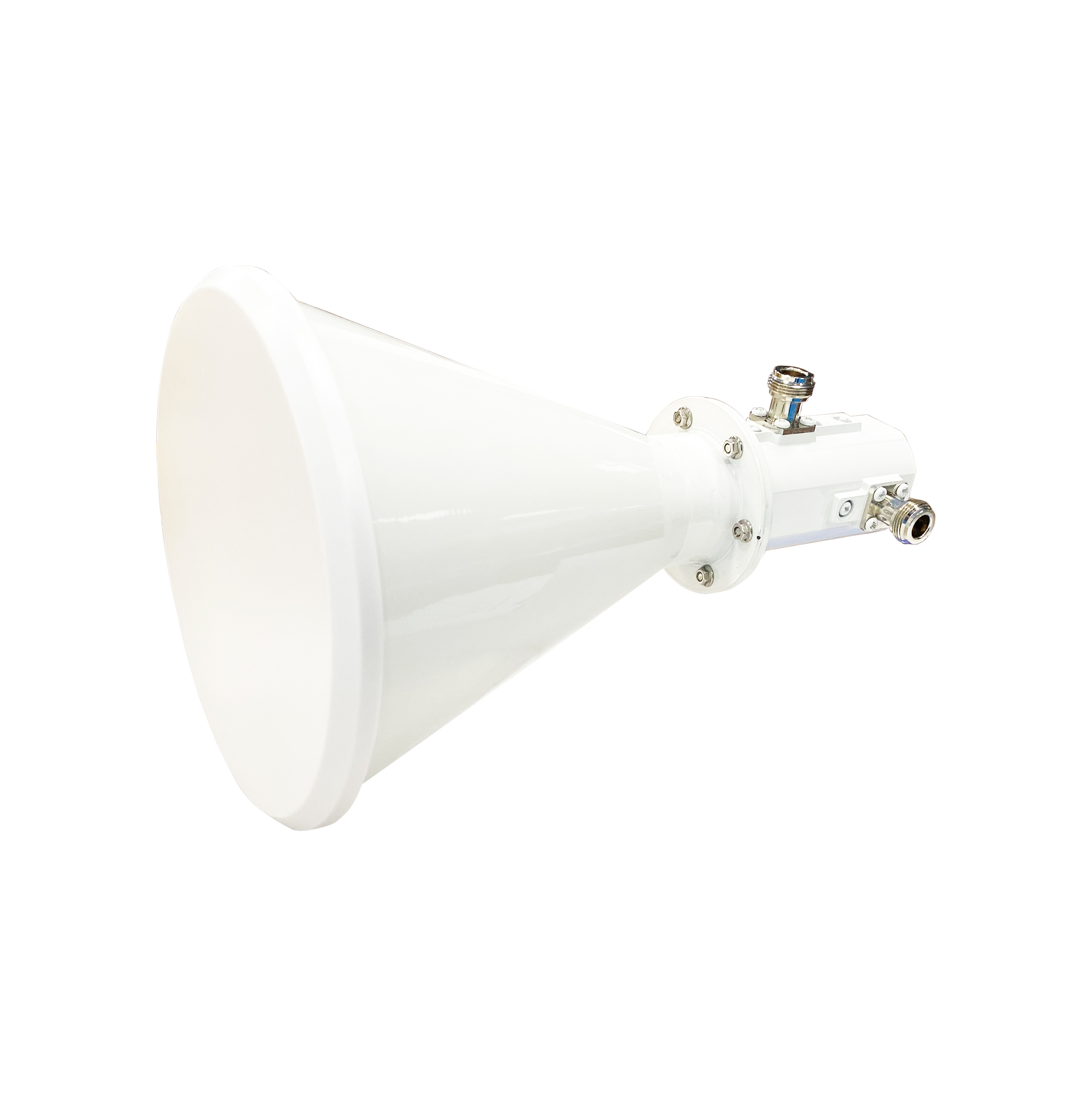
Compact Horn, 30° on the Low Band
BBT-4971HO15HV
4900–7125 MHz
15.5 / 17 / 18 dBi
Horizontal 30° / 24° / 20°
Vertical 24° / 22° / 19°
H/V dual-pol · 2 × N-Female
Φ150 × 240 mm · 0.45 kg
View Detail
Need a beam between the two? The BBT-4971HO19HV delivers 17.5 / 19 / 19 dBi with a 23° / 23° / 20° horizontal beam. All four models belong to BBT's Horn 4900–7125 MHz range.
Gain and Beamwidth by Band
A horn's beam narrows as frequency rises, so a "20°" or "30°" label only holds on part of the band. Pick the model by the band your radios actually run.
| Model | Band (MHz) | Gain | Horizontal beamwidth (3 dB) | Vertical beamwidth (3 dB) |
|---|---|---|---|---|
| BBT-4971HO20R-N2 Round horn |
4900–5400 | 19 dBi | 20° | 17° |
| 5400–6400 | 20 dBi | 17° | 15° | |
| 6400–7125 | 20.5 dBi | 15° | 15° | |
| BBT-4971HO19HV Round horn |
4900–5400 | 17.5 dBi | 23° | 20° |
| 5400–6400 | 19 dBi | 23° | 18° | |
| 6400–7125 | 19 dBi | 20° | 17° | |
| BBT-4971HO15HV Compact round horn |
4900–5400 | 15.5 dBi | 30° | 24° |
| 5400–6400 | 17 dBi | 24° | 22° | |
| 6400–7125 | 18 dBi | 20° | 19° | |
| BBT-4971HO18HV-N2 Rectangular, asymmetrical horn |
4900–5400 | 16.5 dBi | 40° | 20° |
| 5400–6400 | 17.5 dBi | 36° | 19° | |
| 6400–7125 | 17.1 dBi | 30° | 18° |
Nominal values from BBT product specifications, with tolerances of ±0.5 dBi for gain and ±3° to ±5° for beamwidth. All four models share H/V dual polarization, 2 × N-female connectors, VSWR ≤2.0, a front-to-back ratio of ≥25 dB, port-to-port isolation of ≥25 dB, 50 Ω impedance, 100 W max input, DC grounding, an aluminium alloy body with a white radome, -40 °C to +60 °C operation, Φ30–60 mm pole mounting and a 60 m/s rated wind velocity.
Symmetrical or Asymmetrical Horn Antennas?
Horns come in two beam shapes, and BBT ANTENNAS builds both. Our horn vs dish comparison explains how a horn forms its beam. On a tower, that shape decides how each sector behaves.
- Symmetrical (round) horns keep the horizontal and vertical beams close. The BBT-4971HO20R-N2 runs 20° / 17° / 15° horizontally and 17° / 15° / 15° vertically across its three bands. That clean, focused beam suits long-range, high-density sectors where every degree of isolation counts.
- Asymmetrical (rectangular) horns open up the horizontal beam and keep the vertical beam tight. The BBT-4971HO18HV-N2 runs 40° / 36° / 30° horizontally against 20° / 19° / 18° vertically, so it covers a wider arc with fewer units while still holding down noise from the ground and sky.
Use round horns where distance and frequency reuse matter most, and rectangular horns where one mount has to cover a broad neighborhood. Many towers mix both, with a 20° horn aimed at a distant cluster beside 30°-class horns serving nearby streets.
One Antenna, All Frequencies: 4.9 to 7.1 GHz
Future-proofing is critical. Hardware that only supports legacy 5 GHz bands is a risk as networks move to WiFi 6E and WiFi 7.
BBT ANTENNAS builds its 4900–7125 MHz horn antennas as true ultra-wideband designs. The same physical antenna supports:
- Public safety (4.9 GHz)
- Unlicensed 5 GHz (UNII-1, 2, 3)
- New 6 GHz spectrum (5925–7125 MHz)
WISPs can upgrade their radios to newer 5 GHz standards or 6 GHz proprietary protocols without paying for a tower climb to change the antenna. The horn you install for 5 GHz today is ready for 6 GHz radios tomorrow. The radio sets which channels run within local spectrum rules. Expect the beam to tighten toward the top of the band, as the table above shows.
Talk to our engineers about your WISP tower upgrade, and we will reply with a horn antenna quote as soon as possible.
Get a Horn Antenna QuoteWhy WISPs Source Horn Antennas from BBT ANTENNAS
From the surgical precision of a 20° beam to the balanced coverage of a 30° beam, the shift to horn technology is inevitable for WISP networks that keep growing. BBT ANTENNAS designs and manufactures these horns in Foshan, China, for wireless ISPs, network integrators and wireless equipment makers.
- A complete WISP horn line: four dual-polarized models covering 4900–7125 MHz at 15.5 to 20.5 dBi, in round and rectangular formats. BBT's official catalog lists its horn antennas in the WLAN and WiFi range for point-to-point and point-to-multipoint systems.
- Built for exposed towers: DC-grounded lightning protection, a 60 m/s rated wind velocity and -40 °C to +60 °C operation on every model.
- Tested in-house: network analyzers for RF verification, plus rain and salt-spray test equipment.
- More than 30 years in antennas: BBT's history begins in 1991.
- Scale and engineering depth: more than 200 staff, including RF, microwave, simulation and structural engineers, and a 30,000 m² workshop for R&D and production.
- Certified quality systems: ISO 9001:2015 and ISO 14001:2015.
- Four-stage quality control: raw material, in-process, final and pre-shipment inspection.
- Customization and OEM/ODM: custom frequency band, gain, beamwidth, polarization, connectors and housing color.
Need a custom band, beamwidth or connector? We provide custom and OEM/ODM horn antennas. Pricing is quoted per project, and samples are available for evaluation. See our Custom & OEM antenna manufacturing page.
WISP Horn Antenna FAQ
Should I choose a 20° or 30° horn antenna for my WISP tower?
Choose 20° horns for distant client clusters, crowded towers and noisy urban spectrum. They deliver the highest gain, up to 20.5 dBi on the BBT-4971HO20R-N2, and stack side by side with minimal separation. Choose 30° horns for micro-PoPs, rooftops and scattered subscribers, where a wider arc and fewer units matter more. Many towers use both.
How many horn antennas do I need to cover 360°?
At nominal beamwidth, full 360° coverage takes 12 horns at 30° or 18 horns at 20°. In practice, size the layout by where your subscribers actually are and how much overlap you leave between sectors. Many sites only need to cover the arcs where customers live, which reduces the count further.
What are the benefits of horn antennas compared with 90° or 120° sector antennas?
A horn confines energy to a much narrower horizontal beam with low side lobes, so one tower can carry more sectors and reuse channels more often with less self-interference. BBT horns specify a front-to-back ratio and port-to-port isolation of at least 25 dB each. A sector panel covers more area per unit, so it still suits lightly loaded sites.
What is the difference between symmetrical and asymmetrical horn antennas?
A symmetrical horn has similar horizontal and vertical beamwidths. BBT's round BBT-4971HO20R-N2 is 20° by 17° at 4.9–5.4 GHz, a clean beam for long-range, high-density sectors. An asymmetrical horn is wide horizontally and narrow vertically. BBT's rectangular BBT-4971HO18HV-N2 is 40° by 20° in the same band, covering a wider arc while limiting noise from the ground and sky.
Can the same horn antenna run on both 5 GHz and 6 GHz?
Yes. BBT horns cover 4900–7125 MHz, which includes 4.9 GHz public safety, the 5 GHz UNII-1, UNII-2 and UNII-3 bands and 6 GHz spectrum from 5925 to 7125 MHz. The radio decides which band actually runs, within local regulations, so you can upgrade radios without changing the antenna. Beamwidth narrows toward the top of the band.
Can BBT horn antennas connect to my existing radio, and can you customize them?
Yes. Each BBT horn has two N-female ports, one per polarization, so it connects to 2×2 radios with N-type antenna connectors. Radios with built-in antennas and no external ports cannot use an external horn. BBT ANTENNAS also provides custom and OEM/ODM manufacturing with custom band, gain, beamwidth, connector or housing color. Pricing is quoted per project, and samples are available.
Ready to break through the density wall on your towers? Talk to our engineering team about which beamwidth fits your topology, and we will reply with a quote as soon as possible.
Request a WISP Horn Antenna QuoteNeed a custom horn? Explore custom and OEM/ODM horn antennas