

Point-to-point antennas are pairs of high-gain directional antennas aimed at each other and connected to wireless bridge radios. They link fixed sites: building to building, out to a remote camera or AP pole, or up to a backhaul tower. Choose dish antennas for long links, grid antennas for windy sites and 2.4 GHz, and panels for short hops. BBT ANTENNAS supplies 2.4, 3.5 and 5 GHz models and builds custom versions.
Last updated: October 2026How a Point-to-Point Wireless Link Works

The application case above shows point-to-point directional transmission between two buildings. In Building A, the internet connection comes in through a modem and feeds a wireless AP bridge. A coaxial cable runs from the bridge up to a pole-mounted dish antenna, which beams the signal across to Building B. There, a matching dish antenna picks it up and sends it down a coaxial cable to a second wireless AP bridge, and a connect cable joins that bridge to a computer. A computer in Building A connects to its bridge the same way, so both buildings share one network with no fiber trench between them.
The antennas decide how far and how reliably that link runs. Each one focuses the radio's energy into a narrow beam, so the two ends hear each other clearly over distance while signals from other directions are pushed down. Typical uses include:
- Extending an office, factory or campus LAN to a second building
- Bringing video from remote surveillance cameras back to a control room
- Feeding remote outdoor access points, as covered in our outdoor WiFi coverage guide
- Backhaul between wireless ISP towers
- Connecting offices, gates and equipment across ports, mines and farms
BBT ANTENNAS supplies the antennas in this chain. They connect to bridge radios with external antenna ports (N-type on the dish, grid and panel models below), so you keep the radio platform you already use. This guide covers fixed data links between sites. Home WiFi extenders and TV or satellite reception are outside its scope.
Choosing Point-to-Point Antennas by Link
Start with the link itself: how far it runs, which band your radios use and what the mounting position has to withstand. Distances below are relative, because the reach of any antenna pair also depends on the radios at each end.
| Link scenario | Challenge | Recommended antenna type | BBT product |
|---|---|---|---|
| Short links between buildings on one campus | Close range, limited roof or wall space and other radios nearby | High-gain dual-polarized panel antennas | Dual-pol panel antenna, 23 dBi (BBT-5158PA23R009) |
| Medium links across factory, port or yard sites | Exposed masts, strong wind and interference from neighboring radios | Grid antennas, whose open frame lets wind pass through | 5 GHz grid antenna, 29 dBi (BBT-5158PW29V06) For 2.4 GHz: grid antenna, 24 dBi (BBT-2425PW24V06) |
| Long links to remote sites or backhaul towers | The link needs maximum gain, and the beam must stay locked on the far end | High-gain dish antennas, up to 34 dBi | Dual-pol dish antenna, 34 dBi (BBT-5159PM34D12-N2) or dish antenna, 34 dBi (BBT-5259PM34V12) |
| Projects on the 3.5 GHz band | Radios run on 3.4 to 3.8 GHz instead of the WiFi bands | Dish antennas for 3.4 to 3.8 GHz, dual-polarized for 2×2 MIMO radios | Dual-pol dish antenna, 27 dBi (BBT-3638PM27R09-N2) Full range: 3.5 GHz dish antennas |
| Short 6 GHz links for WiFi 6E and WiFi 7 radios | New 6 GHz radios need antennas that cover the upper band | Horn antennas covering 4900–7125 MHz | 5G 6G & WiFi 7 horn antenna, 17.5–19 dBi (BBT-4971HO19HV) |
| One site serving many subscribers | This is point-to-multipoint access rather than a one-to-one link | Sector or horn antennas at the base site, CPE antennas at each subscriber | See WISP horn antenna guide |
BBT Point-to-Point Antennas
The long, medium and short links in the table map to three 5 GHz models, the band most point-to-point bridges run on: a 34 dBi dish for long links, a 29 dBi grid for exposed medium-range sites and a 23 dBi panel for short hops between buildings. The two dual-polarized models connect directly to 2×2 MIMO radios.


Need a different band or polarization? Compare the single-polarized Dish Antenna (BBT-5259PM34V12, 5200–5900 MHz, 34 dBi, F/B ≥ 38 dB), the 2.4 GHz Grid Antenna (BBT-2425PW24V06, 2400–2500 MHz, 24 dBi), the 3.5 GHz Dual-pol Dish Antenna (BBT-3638PM27R09-N2, 3600–3800 MHz, 27 dBi) and the 6 GHz 5G 6G & WiFi 7 Horn Antenna (BBT-4971HO19HV, 4900–7125 MHz, 17.5–19 dBi). You can also browse the full Dish Antenna category, the Dish 2400–6400 MHz range, or BBT 5 GHz dish, 3.5 GHz dish, 2.4 GHz parabolic and panel antennas.
Dish, Grid or Panel: Which Point-to-Point Antenna Fits?
All three types trade beamwidth for reach. The narrower the beam, the higher the gain and the longer the link can run, as our article on antenna gain vs directivity explains. In practice, the choice comes down to link distance, antenna size and the wind at the mounting point.
Dish Antennas for Long-Distance Links
A dish uses a parabolic reflector to focus energy into a pencil-thin beam. BBT's dual-pol dish (BBT-5159PM34D12-N2) concentrates 34 dBi into a 3° beam from a Φ1200 mm aluminium alloy reflector, the right tool for long links to remote sites and backhaul towers. Its anti-UV, anti-aging coating gives strong resistance to corrosion and wind. The trade-off is size: a large reflector catches more wind and needs a rigid mount and careful alignment. Our comparison of horn vs dish antennas explains when each fits, and our overview of internet dish antenna advantages covers fixed broadband use. Browse BBT 5 GHz dish antennas.
Grid Antennas for Exposed and Windy Sites
A grid antenna replaces the dish's reflector with an open aluminium grid, so wind passes through the frame instead of pushing against it. BBT's 5 GHz grid (BBT-5158PW29V06) reaches 29 dBi with a 6° / 4° beam on a 600 × 900 mm frame. Grids are also a common choice at 2.4 GHz, where the longer wavelength calls for a large reflector and the open frame keeps wind load down. The BBT-2425PW24V06 delivers 24 dBi across 2400–2500 MHz. Choose grid antennas for masts on factory roofs, port yards and hilltops. See the 29 dBi grid antenna.
Panel Antennas for Short Links Between Buildings
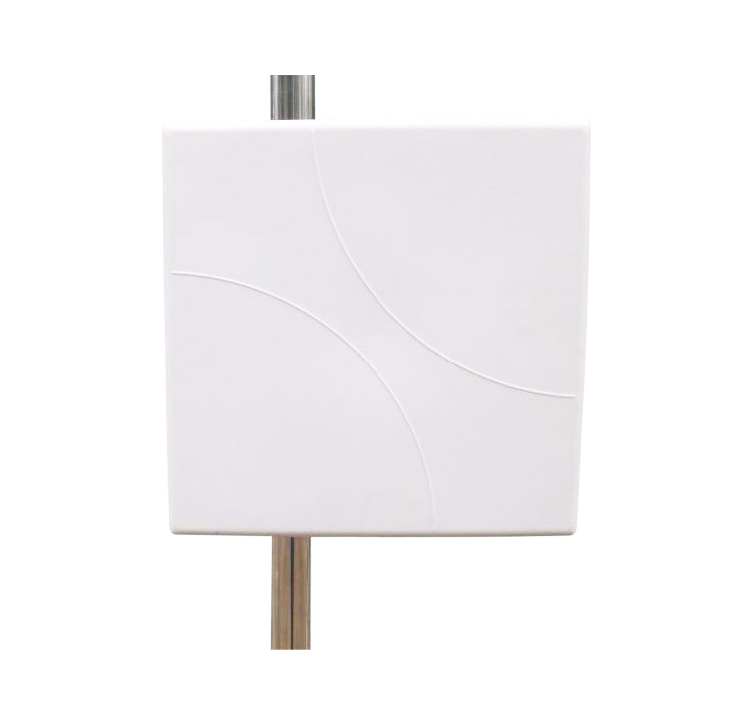
A flat panel packs high gain into a compact housing that mounts on a wall or short pole. BBT's dual-pol panel (BBT-5158PA23R009) delivers 23 dBi with a 9° / 8° beam and a front-to-back ratio of at least 30 dB in a 385 × 385 × 30 mm package. It is waterproof to IP67, available with a die-cast shell and built for strong anti-interference performance. Its wider beam makes alignment quicker than with a dish, which suits short hops across a campus or between neighboring buildings. Learn what panel antennas are used for, or browse BBT panel antennas.
How the three types compare across BBT's point-to-point range:
| Antenna type | Typical beamwidth (BBT example) | BBT gain range | Size example | Wind load | Best-fit link |
|---|---|---|---|---|---|
| Dish / parabolic | 3° / 3° (34 dBi) | 17–34 dBi | Φ1200 mm (34 dBi) | Highest, with the largest reflector area | Long links to remote sites and backhaul towers |
| Grid | 6° / 4° (29 dBi) | 15–29 dBi | 600 × 900 mm open grid (29 dBi) | Lower, as wind passes through the grid | Medium links, exposed masts and 2.4 GHz links |
| Panel (5 GHz) | 9° / 8° (23 dBi) | 15–26 dBi | 385 × 385 × 30 mm (23 dBi) | Lowest, with a compact flat housing | Short links between nearby buildings |
The featured dish, grid and panel models all carry a 60 m/s rated wind velocity.
Planning a Point-to-Point Link: What to Check Before You Order
The antennas are one part of the link budget. Check these points before you finalize the design:
- Line of sight between the two antennas
- First Fresnel zone around the path
- Inner 60% of the zone: keep it clear of trees, roofs and terrain
- Gain at both ends: antenna gain counts twice in a link budget, once at each end, so it is the biggest lever you control after the radios themselves. Moving from a pair of 23 dBi panels to a pair of 34 dBi dishes adds 22 dB to the link.
- Line of sight and Fresnel zone clearance: the path needs a clear line of sight plus open space around it. A common rule of thumb is to keep at least 60% of the first Fresnel zone free of trees, roofs and terrain, so mount the antennas high enough to clear obstacles in the middle of the path.
- Polarization and MIMO: a dual-polarized antenna (±45° or vertical/horizontal) with two N connectors serves both chains of a 2×2 MIMO radio. Use the same polarization type at both ends so each chain lines up with its partner.
- Alignment and mounting: a 3° beam leaves little margin, so the antenna must be aimed precisely and held there in high wind. The featured BBT dish, grid and panel models fit Φ30–60 mm poles and carry a 60 m/s rated wind velocity.
- Interference rejection: a high front-to-back ratio keeps signals arriving from behind the antenna out of the receiver, which matters in busy 5 GHz areas. The BBT-5259PM34V12 dish specifies at least 38 dB and the BBT-5158PA23R009 panel at least 30 dB.
- Weather and lightning: the featured dish, grid and panel models are DC grounded for lightning protection and rated for -40 °C to +60 °C operation.
- Cable length: as the diagram shows, a coaxial cable joins each bridge to its antenna, and every meter of coax adds loss. Mount the bridge close to the antenna to keep that run short.
Not sure how much gain your link needs? Send the link distance, frequency band and radio model at each end. BBT ANTENNAS will calculate the gain the link needs, match suitable antenna models and quote by project, with samples available for evaluation.
Send Your Link DetailsPoint-to-Point or Point-to-Multipoint?
Point-to-point is a one-to-one link: a backbone or backhaul connection between two fixed sites, with a matched antenna at each end. When one site has to serve many subscribers around it, as in a wireless ISP network, the design becomes point-to-multipoint. Sector or horn antennas at the base site cover the surrounding area, and each subscriber connects through a CPE antenna. Browse horn antennas, 4900–7125 MHz and read the guide to deploying 20° and 30° horn antennas.
Many projects combine both. A point-to-point link carries traffic out to a remote site, and coverage antennas there serve users across the area. For the coverage side, see our outdoor WiFi antenna selection guide.
Why Integrators and Equipment Brands Source from BBT ANTENNAS
BBT ANTENNAS designs and manufactures point-to-point antennas in its own factory in Foshan, China, for system integrators, wireless ISPs, industrial network teams and overseas equipment brands.
- A complete point-to-point line: dish, parabolic, grid and panel antennas for 2.4, 3.5 and 5 GHz, plus horn antennas for 4900–7125 MHz, in single- and dual-polarized versions. BBT's official catalog lists its parabolic and grid antennas for long-distance wireless transmission, point-to-point links and image, audio and data transmission.
- Built for exposed masts: DC-grounded lightning protection, 60 m/s rated wind velocity and a -40 °C to +60 °C operating range on the featured dish, grid and panel models.
- Tested in-house: network analyzers for RF verification, plus rain, salt-spray, drop, UV-aging and thermal-shock test equipment.
- More than 30 years in antennas: BBT's history begins in 1991, with overseas marketing since 1998.
- Scale and engineering depth: more than 200 staff, including RF, microwave, simulation and structural engineers, and a 30,000 m² IoT Industrial Park workshop for R&D and production.
- Certified quality systems: ISO 9001:2015 and ISO 14001:2015, plus independent intellectual property and product patents.
- Four-stage quality control: raw material, in-process, final and pre-shipment inspection.
- OEM/ODM for your brand: custom frequency band, gain, polarization, connectors, housing color, private-label branding and packaging.
Selling wireless bridges or radios under your own brand? BBT ANTENNAS builds private-label point-to-point antennas matched to your radio's band, ports and connectors, so you can offer complete link kits under one name. See how we work with brands and distributors on the Custom & OEM antenna manufacturing page.
Point-to-Point Antenna FAQ
How far can a point-to-point antenna link reach?
Range depends on the whole link rather than the antenna alone: antenna gain at both ends, radio transmit power and receiver sensitivity, cable loss, the frequency band and how clear the path and its Fresnel zone are. The same pair of antennas can cover very different distances with different radios. Send BBT ANTENNAS your link distance and radio models, and our engineers will calculate the antenna gain you need and recommend a matching pair.
Should I use a dish, grid or panel antenna for a point-to-point link?
Use a dish for long links that need maximum gain. BBT's 5 GHz dishes reach up to 34 dBi with a 3° beam. Use a grid antenna on exposed, windy masts and for 2.4 GHz links, since the open frame lets wind pass through. Use a panel for short hops between nearby buildings, where a compact housing and a wider beam make installation and alignment easier.
Do both ends of a point-to-point link need the same antenna?
Both ends must use the same frequency band and the same polarization, and each antenna must be aimed at the other. The gain can differ, as long as the combined link budget still delivers enough signal. For example, a larger dish can go on the remote mast where there is room, with a smaller antenna at the end where space is tight. Identical pairs remain the simplest option because the link then performs the same in both directions.
Should I choose 2.4 GHz, 5 GHz, 3.5 GHz or 6 GHz for a point-to-point link?
5 GHz is the most common band for point-to-point bridges, with wide channels and compact high-gain antennas. 2.4 GHz copes better with long paths and light obstructions but carries less capacity and is often crowded. 3.5 GHz serves fixed wireless access systems built on that spectrum, and 6 GHz adds new channels for WiFi 6E and WiFi 7 radios where local rules allow outdoor use. Choose the band your radios support, then match the antenna. BBT ANTENNAS covers 2400–2500 MHz, 3400–3800 MHz, 5100–5950 MHz and 4900–7125 MHz.
Can BBT point-to-point antennas connect to my existing wireless bridge?
Yes, if your bridge or radio has external antenna ports. Match the frequency band, the number of ports and the connector type. The dish, grid and panel models featured on this page use N-type female connectors, with two ports on the dual-polarized versions for 2×2 MIMO radios. All-in-one bridges with built-in antennas and no external ports cannot take an external antenna. Send us your radio model and we will confirm compatibility.
Can BBT ANTENNAS make point-to-point antennas under our brand?
Yes. BBT ANTENNAS provides OEM and ODM manufacturing for antenna brands, distributors and wireless equipment makers, including bridge brands that want antennas to bundle with their radios. We can adjust frequency band, gain, polarization, connector type and housing color, and apply your logo and packaging. Pricing is quoted per project, and samples are available for evaluation before volume orders.
Planning a building-to-building link, camera backhaul or tower-to-tower connection? Send your band, link distance, radio model and quantities. BBT ANTENNAS will recommend a matched antenna pair and quote by project.
Request a Point-to-Point Antenna QuoteSelling bridges or radios under your own brand? Explore OEM/ODM manufacturing