
A distributed antenna system (DAS) is a network of antennas spread through a building, venue or tunnel and connected by coaxial cable, fiber or both to a common signal source. It delivers in-building cellular and public safety coverage where outdoor signals cannot reach. Performance depends on three layers: the signal source, the distribution network and the coverage antennas.
Last updated: October 2026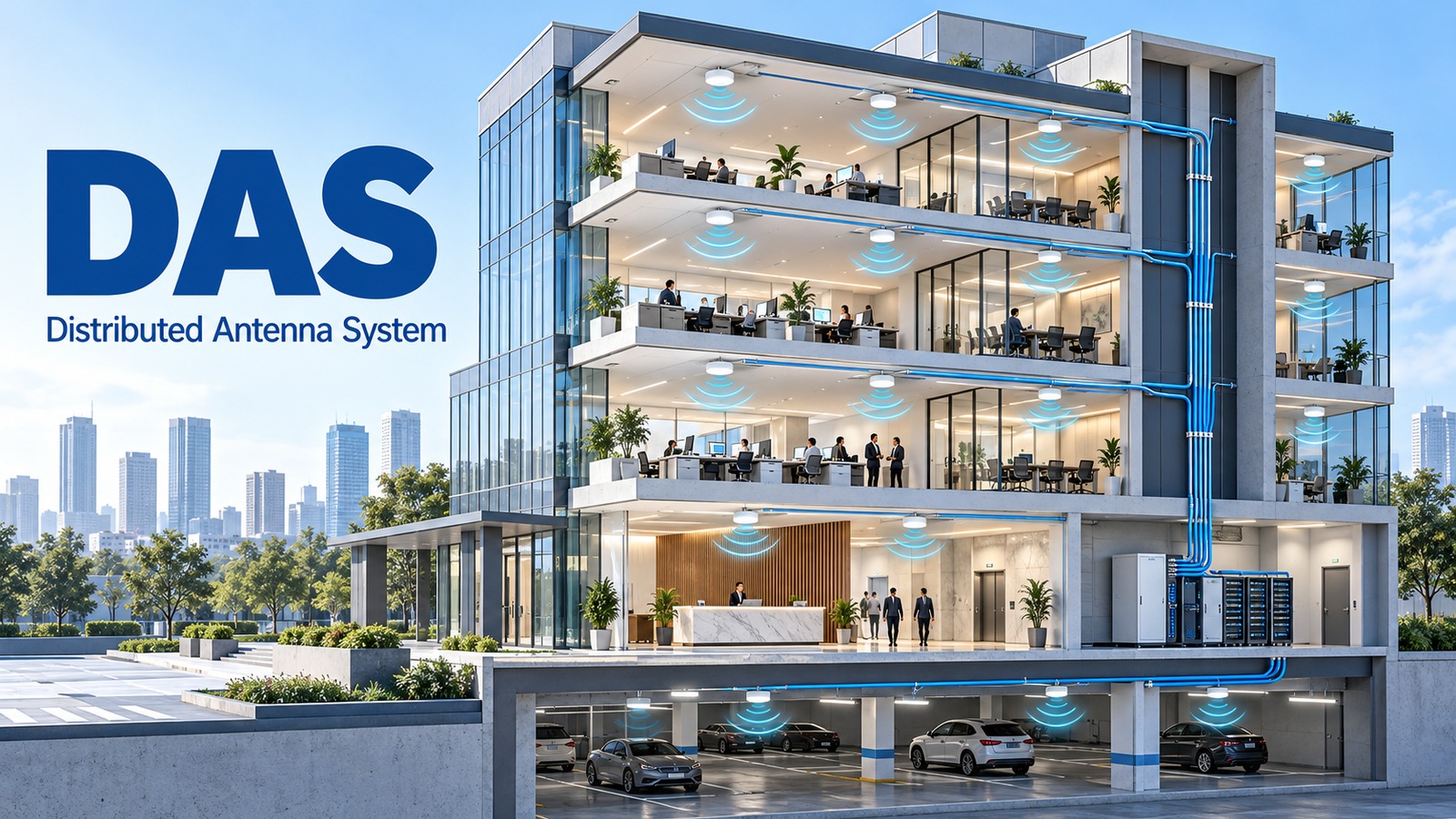
What Is a Distributed Antenna System (DAS)?
A distributed antenna system (DAS) is a set of low-power antennas installed throughout a building or site and fed from one shared signal source, so every antenna carries the same operator or radio signals. The system brings the signal indoors and releases it close to the people who use it, floor by floor and zone by zone.
Buildings need this because modern construction blocks radio waves. Low-E coated glass, reinforced concrete, steel frames and underground levels can weaken an outdoor signal until calls drop and data stalls. Capacity is the second problem. A stadium, airport terminal or rail station can hold thousands of phones in one space, more than a nearby macro cell can serve. A DAS fed by its own base station capacity solves both problems, and even a DAS that picks up an outdoor signal off the air restores usable coverage in dead zones.
Most systems are indoor DAS, covering floors, corridors, lift lobbies and car parks inside one building or campus. Outdoor DAS applies the same idea to open sites, with antenna nodes on poles, rooftops and structures around stadium grounds, campuses and busy streets.
Typical sites include offices, hospitals, hotels, shopping malls, airports, rail and metro stations, stadiums, tunnels and factories. The guides listed near the end of this page cover antenna choices venue by venue.
How a DAS Works: Signal Source, Distribution and Antennas
Every DAS has three layers: a signal source that brings operator signals into the system, a head-end and distribution network that carries them through the building, and antennas that radiate them to users. The weakest layer sets the performance of the whole system.
Downlink: source to usersUplink: phones and radios back to the source
| Layer | What it does | Typical equipment | What the antenna does at this layer |
|---|---|---|---|
| 1. Signal source | Brings each operator's signal into the DAS | Off-air: a rooftop donor antenna plus a bi-directional amplifier (BDA) or repeater. Operator-fed: a dedicated base station or small cell | On off-air systems, a directional donor antenna aims at the chosen outdoor cell site and captures a clean signal. Base station and small cell feeds connect by cable and need no donor antenna |
| 2. Head-end and distribution | Combines, conditions and divides the signal, then carries it across floors and zones | Passive: coaxial cable, splitters, couplers and combiners. Active: head-end unit, fiber and remote units | No antennas here, but cable loss, power per port and the number of outputs set what each coverage antenna must deliver |
| 3. Coverage antennas | Radiate the downlink to users and collect their uplink | Ceiling omni antennas, wall-mount panels, log-periodic antennas | Shape coverage zone by zone: 360° over open areas, directional beams along corridors, tunnels and building edges |
Signal flows both ways. On the downlink, the source feeds the head-end, the distribution network divides the signal and each antenna covers its zone. On the uplink, each antenna picks up nearby phones and radios and sends their signals back along the same path to the source.
BBT ANTENNAS supplies the antennas at both ends of this chain: donor antennas for off-air signal sources and coverage antennas for the final layer. Amplifiers, repeaters, splitters, couplers, head-end units and remote units come from DAS equipment vendors. Our antennas connect to that equipment through standard 50 Ω interfaces with N or 4.3-10 connectors, so integrators can pair them with the electronics their design already specifies.
For the bigger picture of indoor coverage design, our guide to the in-building solution (IBS) explains how signal sources, passive components and indoor antennas fit together in one project.
Which Antennas Go Where in a DAS
Antenna type follows the shape of the space: ceiling omni antennas for open areas, directional wall-mount panels for corridors and building edges, and log-periodic antennas for long, narrow spaces and rooftop donor links. Most buildings use a mix.
| Antenna type | Pattern | Best locations | BBT typical gain | Where to start |
|---|---|---|---|---|
| Ceiling omni (single-port, 2T2R or 4T4R MIMO) | 360° horizontal | Open office floors, lobbies, shop floors, waiting areas | 2–6 dBi | Ceiling antennas |
| Wall-mount directional panel | Directional, 30°–90° horizontal depending on band | Corridors, building edges, high-ceiling halls, areas without ceiling access | 5–9 dBi | Wall-mount antennas |
| Log-periodic | Directional, 50°–65° horizontal | Long halls, tunnels, platforms and car park ramps; rooftop donor antenna on off-air systems | 10–11 dBi | Log-periodic antennas |
| Multiband ceiling (cellular plus professional radio) | 360° horizontal | Buildings that need radio and cellular coverage from one antenna position | 2–4 dBi | Multiband ceiling antenna |
For a closer comparison of antenna designs, see our guide to DAS antenna types. To match antennas to offices, malls, airports, hotels and car parks, see indoor DAS antennas by venue.
Three BBT models cover the main jobs in the table: 4T4R MIMO capacity over open floors, radio and cellular coverage from one ceiling antenna, and long-reach or donor coverage from a wideband log-periodic antenna.

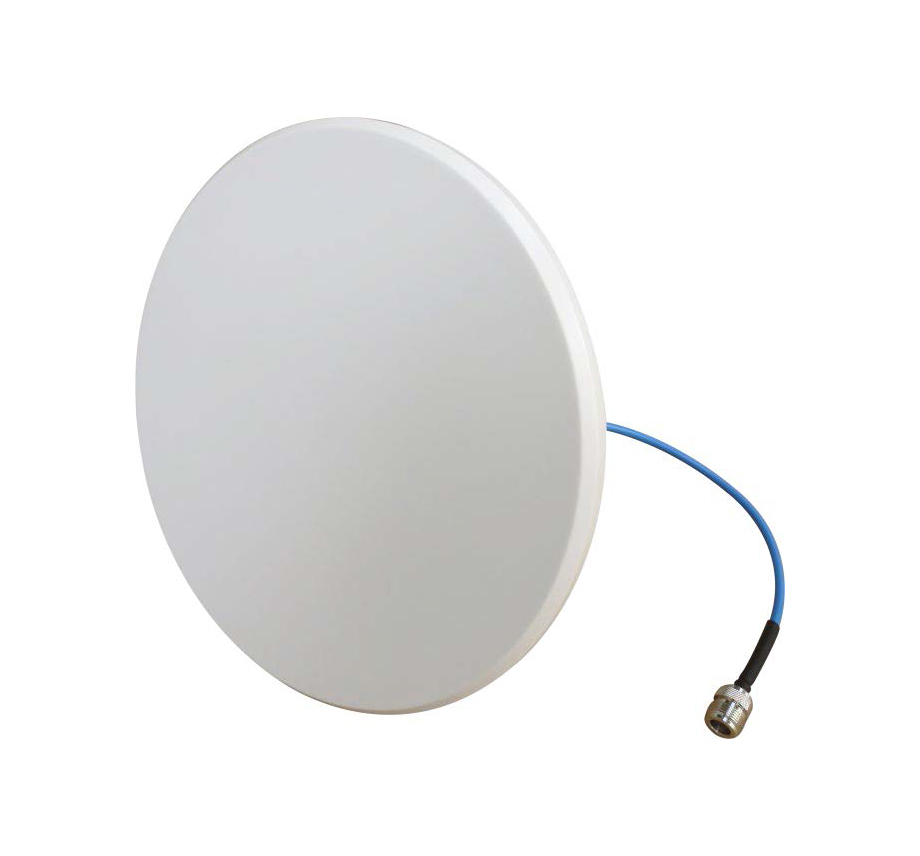
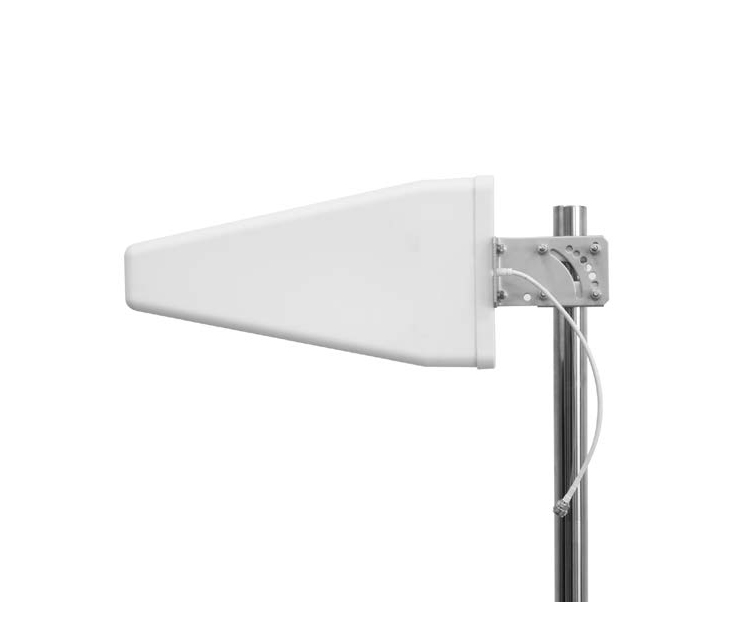
Need a different port count or band? Compare the 2T2R ceiling antenna (BBT-0660CL0306H2), the 380–430 MHz ceiling antenna (BBT-0304CL02H), the five-band wall-mount antenna (BBT-0660WL0509V-180) with bands from 617 to 6000 MHz, and the 4T4R MIMO wall-mount antenna (BBT-0660WL0609R090-M4). You can also browse the full ceiling, wall-mount and log-periodic antenna ranges.
Antenna Specs That Decide DAS Performance
Frequency coverage, MIMO port count and passive intermodulation (PIM) decide most of what an antenna adds to a DAS. Connectors, VSWR, power rating and housing complete the picture. The reference values below come from BBT product specifications.
| Specification | Why it matters in a DAS | BBT reference value |
|---|---|---|
| Frequency coverage | Every operator band in the design must be covered. Wideband antennas avoid re-cabling and re-mounting when new bands arrive | 617–960 / 1710–2700 / 3300–4200 / 4900–6000 MHz (2T2R and 4T4R ceiling) |
| MIMO ports | Each port carries one transmit/receive path. 2T2R and 4T4R antennas add data streams for 4G and 5G capacity. Match the port count to the remote unit | Single-port, 2T2R and 4T4R ceiling models; 4T4R wall-mount |
| Third-order intermodulation (IM3) | With several carriers on one antenna, intermodulation products can fall into uplink bands and raise the noise floor. Compare IM3 only at the same test power | ≤ -150 dBc with 2 × 43 dBm carriers (2T2R, 4T4R and multiband ceiling; five-band wall-mount) |
| Connectors | 4.3-10 connectors are compact and built for stable low-PIM contact in multi-operator systems. N-type stays common in single-operator designs | 4.3-10 Female (2T2R and 4T4R ceiling); N-Female (multiband ceiling, five-band wall-mount, log-periodic) |
| VSWR and port isolation | Low VSWR reflects less power back down the cable. High isolation keeps MIMO streams apart | VSWR ≤1.8 in all four bands; isolation ≥15 / 20 / 23 / 23 dB (4T4R ceiling) |
| Maximum input power | The rating must exceed the power delivered to the antenna port, with margin for several carriers | 50 W (ceiling and wall-mount models); 100 W (log-periodic) |
| Profile and radome | A slim, neutral housing passes architectural review in hotels, offices and retail spaces | Φ235 × 10 mm white ABS (multiband ceiling); Φ360 × 18 mm (4T4R ceiling); -40 °C to +60 °C operation |
Antennas that stop at 2700 MHz cannot carry the 3300–4200 MHz range that many operators use for 5G, so check band coverage first. If your project is planning 5G DAS coverage, choose antennas that already reach 3300–4200 MHz and carry the MIMO ports your radios need.
PIM ratings are easy to misread across datasheets, and our guide to low-PIM DAS antennas shows how to compare them fairly. For a step-by-step method covering coverage area, bands, gain and installation environment, see our article on choosing a DAS antenna.
Our engineers will match BBT antennas to your building and band plan and send you a quote as soon as possible.
Get a DAS Antenna QuotePassive vs Active vs Hybrid DAS
Passive DAS suits small and mid-size buildings, active DAS suits large multi-operator sites, and hybrid DAS sits in between. The difference is how the signal travels from the head-end to the antennas, and that changes which antenna specifications matter most.
| Architecture | How the signal travels | Best fit | Expansion and cost | What it means for the antennas |
|---|---|---|---|---|
| Passive DAS | RF over coaxial cable, divided by splitters and couplers, with no active electronics between the head-end and the antennas | Small and mid-size buildings with one or a few operators | Lowest equipment cost. Loss grows with every cable run, and adding bands means rechecking the whole network | Little power reaches the far antennas, so gain, low VSWR and low passive intermodulation (PIM) decide edge coverage |
| Active DAS | Converted at the head-end and sent over fiber to remote units that amplify the signal and convert it back to RF near the antennas | Large campuses, hospitals, airports and stadiums with several operators | Higher equipment cost. Scales across floors and buildings, with bands and capacity added at the head-end | Many antenna points, each carrying several bands, so multiband coverage, MIMO ports and matching connectors matter most |
| Hybrid DAS | Fiber to each floor or zone, then short coax runs from a remote unit to several passive antennas | Mid-size to large buildings that need fiber reach at a controlled cost | Mid-range cost. Fiber covers the long distances and coax serves each zone | Both sets of demands: low PIM on the coax segments, wideband coverage and MIMO ports at each antenna |
Digital DAS takes active design a step further: it carries the signal as digital data over fiber, so operators can move capacity between zones in software.
In a passive DAS, every meter of coax and every splitter eats into the signal, so antennas at the end of a long run work with little power, and their gain, VSWR and PIM decide whether the far rooms get usable coverage. In an active DAS, remote units sit close to the antennas and power is less of a constraint. The demand moves to the antenna points themselves: there are many of them, each carrying several operators and bands, so wideband coverage and the right number of MIMO ports do most of the work.
Neutral Host DAS: One System for Several Operators
A neutral host DAS is owned and run by a third party, such as the venue owner, an infrastructure company or an integrator, and shared by several mobile operators. Each operator connects its own signal source at the head-end, and all of them share the same antennas. That puts the antennas under the heaviest load in the building: they must cover every operator's bands and keep intermodulation low while several carriers transmit at once. Multiband, low-PIM antennas with 4.3-10 connectors are a common choice for these systems.
Public Safety DAS vs Cellular DAS
A cellular DAS carries mobile operator signals for calls and data. A public safety DAS carries the two-way radio channels used by fire, police and emergency medical teams, so responders keep contact in stairwells, basements and car parks where handheld radios would otherwise lose the signal.
Many fire and building codes require public safety radio coverage in new or renovated buildings. In the United States, the requirements most often cited are IFC Section 510 and NFPA 1225. Rules, frequencies and acceptance tests vary by location, so confirm the requirements with your local authority having jurisdiction (AHJ) before design starts.
At the antenna layer, the main difference is frequency. Public safety radio often runs below 1 GHz. BBT ANTENNAS offers a 380–430 MHz ceiling antenna for private radio networks, and a multiband ceiling antenna that covers 350–380 MHz together with 698–960, 1425–3800 and 4900–6000 MHz in one Φ235 mm radome. Where the system design lets public safety and cellular services share antennas, the multiband model takes a second set of antennas out of the ceiling. Confirm the exact frequencies your local radio system uses, then choose the antenna that covers them.
What Drives the Cost of a DAS
DAS cost is set by the building and the services the system must carry, so there is no standard price. The main cost drivers are:
- Building size and construction: floor area, number of floors, wall materials and underground levels decide how many antennas and how much cable the design needs.
- Operators and bands: every added operator or band brings more signal sources, head-end capacity and combining equipment.
- Architecture: passive systems cost less in equipment, while active and hybrid systems cost more up front and scale better on large sites.
- Public safety coverage: a code-required public safety system adds its own design, equipment and acceptance testing.
- Antenna points and cabling: each antenna position adds mounting work and a cable or fiber run.
- Survey, design and approvals: site surveys, RF design and operator approval all take time and budget.
Antenna choice also shapes long-term cost. Wideband antennas save rework when operators add bands, low-PIM antennas cut troubleshooting time on multi-carrier systems, and fitting the right MIMO port count at the start avoids opening ceilings a second time.
DAS vs Small Cells vs Signal Boosters
Signal boosters suit small buildings, small cells add operator capacity in targeted areas, and a DAS covers large buildings for several operators at once. The options also combine: a small cell can serve as the signal source for a DAS.
| Option | How it works | Best-fit scale | Operator involvement | Antenna setup |
|---|---|---|---|---|
| Signal booster | An amplifier boosts the existing outdoor signal between a donor antenna and a few indoor antennas | Small buildings and single floors | Uses the existing network signal, with no base station connection | One outdoor donor antenna and a few indoor antennas |
| Small cell | A low-power base station adds its own capacity in one zone | Single zones up to mid-size buildings | The operator supplies or approves the unit and its backhaul | Built-in antennas, or external antennas on models with RF ports |
| DAS | A shared antenna network fed by base stations, small cells or off-air sources | Large buildings, campuses and venues with several operators | Operators connect or approve the signal sources | Many ceiling, wall-mount and log-periodic antennas, plus donor antennas on off-air systems |
DAS Guides for Your Project
This page covers DAS as a whole. When your question narrows, these guides go deeper:
- Indoor DAS antennas by venue: which antenna type fits offices, malls, airports, hotels, hospitals and car parks.
- Different types of DAS antennas: ceiling, wall-mount and log-periodic designs compared in more detail.
- How to choose the right DAS antenna: coverage area, frequency bands, gain and installation environment, step by step.
- 5G DAS antennas for indoor connectivity: what 5G changes for indoor coverage and how the antennas support it.
- In-building solution (IBS) guide: how signal sources, passive components and indoor antennas form one indoor coverage system.
- Low-PIM vs standard DAS antennas: when low PIM matters and how to compare PIM ratings.
Why DAS Integrators and Antenna Brands Choose BBT ANTENNAS
BBT ANTENNAS designs and builds DAS antennas in its own factory in Foshan, China, for DAS integrators, operators and overseas antenna brands.
- A complete DAS antenna line: donor and coverage antennas from 350 MHz to 6000 MHz, including 2T2R and 4T4R MIMO ceiling models, wall-mount panels and wideband log-periodic antennas.
- More than 30 years in antennas: BBT's history begins in 1991.
- Scale and engineering depth: more than 200 staff, including RF, microwave, simulation and structural engineers, working from a 30,000 m² IoT Industrial Park workshop for R&D and production.
- Certified quality systems: ISO 9001:2015 and ISO 14001:2015, plus independent intellectual property and product patents.
- Four-stage quality control: raw material, in-process, final and pre-shipment inspection, backed by network analyzers, third-order intermodulation testers and rain, salt-spray, UV-aging and thermal-shock test chambers.
- OEM/ODM for your brand: custom frequency bands, port count, connectors and radome color, with private-label branding and packaging.
Planning your own DAS antenna line or a non-standard design? See how we work with brands and integrators on our custom and OEM DAS antennas page.
Distributed Antenna System FAQ
What does DAS stand for, and what is it used for?
In telecom and building projects, DAS stands for distributed antenna system: a network of antennas spread through a building, venue or tunnel and fed from a shared signal source. It provides reliable indoor cellular coverage and capacity, and it can carry public safety radio for fire, police and emergency teams. Typical sites include offices, hospitals, hotels, malls, airports, stations, stadiums and tunnels.
What is the main difference between active and passive DAS?
A passive DAS sends RF over coaxial cable through splitters and couplers, with no active electronics between the head-end and the antennas. An active DAS sends the signal over fiber to remote units that amplify it close to the antennas. Passive systems cost less and suit small and mid-size buildings with one or a few operators. Active systems cost more and scale to large multi-operator sites. Hybrid systems combine a fiber backbone with short coax runs.
How much does a DAS cost?
There is no standard price. Cost depends on building size and construction, the number of operators and bands, passive or active architecture, whether a public safety system is required, the number of antenna points and cable runs, and the site survey, design and operator approval work. Antenna choice affects long-term cost too: wideband, low-PIM antennas with the right MIMO port count reduce rework when the system expands.
Do DAS antennas support 5G?
Yes, when they cover the 5G bands your operators use. Indoor 5G systems mostly run in sub-6 GHz bands, including the 3300–4200 MHz mid-band. BBT's 2T2R and 4T4R ceiling antennas cover 617–960, 1710–2700, 3300–4200 and 4900–6000 MHz, with MIMO ports for the multiple data streams 5G radios use. Antennas that stop at 2700 MHz must be replaced or supplemented before 5G in the 3300–4200 MHz range can be added.
How many DAS antennas does a building need?
There is no fixed number per floor or per square meter. The count depends on wall and floor materials, layout, ceiling height, user density, the bands in use and the link budget of the DAS equipment. RF designers set antenna numbers and positions from a site survey and coverage prediction. Higher bands such as 3300–4200 MHz usually need antennas placed closer together than low bands.
Can public safety DAS and cellular DAS share antennas?
Sometimes. The system design and the local authority having jurisdiction decide whether the two services may share antennas, so confirm that first. Where sharing is allowed, a multiband antenna that covers both the public safety band and the cellular bands reduces the number of antennas in the ceiling. BBT's multiband ceiling antenna BBT-0360CL0204H-235 covers 350–380 MHz plus 698–960, 1425–3800 and 4900–6000 MHz in one radome.
Can BBT ANTENNAS customize DAS antennas for our brand and project?
Yes. BBT ANTENNAS provides OEM and ODM development for antenna brands, distributors and DAS integrators. We can adjust frequency bands, port count, connector type, gain, cable length and radome color, and apply your logo and packaging. Pricing is quoted per project, and samples are available for evaluation before volume orders.
Planning a DAS for an office tower, hospital, venue or transit hub? Our engineers will match the right antennas to your building and quote quickly.
Get DAS Antennas Matched to Your BuildingBuilding your own antenna range? Explore OEM/ODM DAS antennas