
Indoor DAS antennas are the end points of an in-building 4G/5G distributed antenna system. They radiate operator signals into occupied floors, halls and corridors. Ceiling omni antennas cover open areas, wall-mount panels serve corridors and perimeters, and log-periodic antennas reach long halls and tunnels. BBT ANTENNAS supplies the full range from 617 to 6000 MHz, with OEM/ODM customization.
Last updated: October 2026What Indoor DAS Antennas Solve in a Building
Concrete floors, coated glass, steel frames and basement levels all weaken the signal arriving from outdoor cell sites. Occupants notice it first: calls drop in lift lobbies, mobile data stalls in underground food courts, and staff lose connection in back-of-house areas.
Indoor distributed antennas fix this by bringing the operator signal inside and spreading it through a network of small, low-power antennas fed from the DAS equipment. In offices, shopping malls, airports and other public buildings, a well-planned antenna layout strengthens signal coverage, cuts dead zones and keeps network connections stable. The result is reliable indoor cellular coverage: people can talk, stream and transfer data without interruption, on the top floor or two levels underground.
If you are still planning the wider in-building solution, our IBS indoor coverage guide explains how the system fits together. The sections below focus on the antennas: which type suits each space, and what to specify when you buy.

Choosing Indoor DAS Antennas by Venue
Each building type brings its own coverage problem. Start by matching the space to an antenna type, then refine the band plan and port count. Typical choices for in-building DAS projects:
| Venue | Coverage challenge | Recommended antenna type | BBT product |
|---|---|---|---|
| Office floors | Open-plan areas, meeting rooms and glass partitions, with high user density across the floor | Low-profile ceiling omni antennas, 2T2R or 4T4R MIMO for 5G capacity | 4T4R MIMO Ceiling Antenna |
| Shopping malls and retail | Atriums, shop floors and food courts with heavy peak traffic across many tenants | Ceiling omni antennas over walkways and shop floors, wall-mount panels around atrium edges | 2T2R Ceiling Antenna |
| Airports and rail stations | High ceilings, long concourses, open platforms and multi-operator 5G demand | 4T4R MIMO wall-mount panels on walls and columns, log-periodic antennas along concourses and platforms | 4T4R MIMO Wall Mount Antenna Further reading: airport 5G coverage |
| Hotels and hospitals | Rooms and wards off long corridors, thick walls and a need for discreet equipment | Wall-mount panels in corridors positioned to reach rooms, ceiling omni antennas in lobbies | 2T2R Wall Mount Antenna |
| Underground parking, tunnels and corridors | Long, narrow concrete spaces with little or no outdoor signal | Directional log-periodic antennas aimed along the length of the space | 5G DAS Log-Periodic Antenna |
| Factories and warehouses | Tall racking, metal structures and wide floors that block and scatter signal | Directional wall-mount panels on walls and columns, log-periodic antennas down long aisles | Directional DAS antennas |
Most projects mix types. A shopping mall, for example, may use ceiling omni antennas over the shop floors, wall-mount panels around the atrium and log-periodic antennas in the car park below.

Explore BBT Indoor DAS Antennas
The three antenna types in the table map to these BBT models: a 4T4R MIMO ceiling antenna for open floors, a 4T4R MIMO wall-mount panel for corridors and perimeter zones, and a wideband log-periodic antenna for long halls, tunnels and platforms.

4T4R MIMO Ceiling Antenna
BBT-0660CL0306H4
617–960 / 1710–2700 / 3300–4200 / 4900–6000 MHz
3 / 4.5 / 5.5 / 6 dBi · 360° omni · IM3 ≤ -150 dBc
4 × 4.3-10 Female
View Detail

4T4R MIMO Wall Mount Antenna
BBT-0638WL0609D090-N4
698–960 / 1700–2700 / 3300–3800 MHz
6 / 9 / 8 dBi · ±45° · 90° / 75° / 60° H-beam
4 × N-Female
View Detail
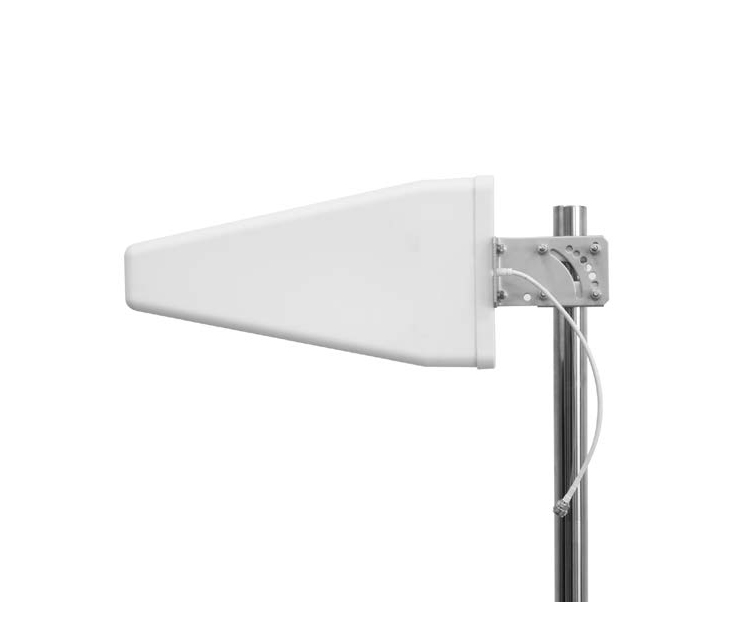
5G DAS Log-Periodic Antenna
BBT-0660LP1011V065
698–960 / 1710–2700 / 3300–6000 MHz
10 / 11 / 11 dBi · 65° / 50° / 50° H-beam
100 W · N-Female · DC grounded
View Detail
Looking for a different port count or form factor? Compare the 2T2R Ceiling Antenna (BBT-0660CL0306H2), the 2T2R Wall Mount Antenna and the single-port Wall Mount Antenna (BBT-0627WL0609V090) for 4G-only zones, or browse the ceiling, directional and log-periodic DAS antenna ranges.
Ceiling, Wall-Mount or Log-Periodic: Which Indoor DAS Antenna Fits?
All three types can run on the same DAS. The right choice depends on the shape of each space, ceiling height, where cable can run and how much capacity the zone needs.
Ceiling omni
360° pattern from the room center. Open floors, shop floors, lobbies.
Wall-mount panel
60°–90° beam from the wall. Corridors, perimeters, high-ceiling halls.
Log-periodic
50°–65° beam with 10–11 dBi gain. Long concourses, tunnels, car parks.
Ceiling Omni Antennas for Open Floors
A ceiling antenna radiates a 360° horizontal pattern from the center of its coverage zone, which suits open-plan offices, retail floors, lobbies and waiting areas. BBT's MIMO ceiling antennas have an 18 mm low profile (Φ360 mm for 4T4R, Φ280 mm for 2T2R) and a white ABS radome that blends into commercial ceilings. Gain rises from 3 dBi at 617–960 MHz to 6 dBi at 4900–6000 MHz, and both versions are rated IM3 ≤ -150 dBc (2 × 43 dBm carriers) with 4.3-10 connectors, ready for multi-operator systems. Full parameters are on the 4T4R MIMO Ceiling Antenna page.
Wall-Mount Panel Antennas for Corridors and Perimeters
A wall-mount DAS antenna sends its energy in one direction, so you can push coverage down a corridor or inward from the building edge while limiting signal leakage outside. BBT's 4T4R model uses ±45° dual polarization across four ports, delivers 6 / 9 / 8 dBi over 698–960, 1700–2700 and 3300–3800 MHz, and narrows its horizontal beam from 90° to 60° as frequency rises. A front-to-back ratio of at least 16 dB (20 dB at 1700–2700 MHz) keeps radiation behind the panel low. The same family includes single-port and 2T2R versions for simpler 4G and dual-stream zones. See the 4T4R MIMO Wall Mount Antenna page for details.
Log-Periodic Antennas for Long Halls, Tunnels and Platforms
A log-periodic DAS antenna combines wide bandwidth with higher gain. BBT's 5G DAS model covers 698–960, 1710–2700 and 3300–6000 MHz in one unit, with 10 / 11 / 11 dBi gain and a 65° / 50° / 50° horizontal beam that reaches down long concourses, tunnels, car park ramps and platforms. It accepts up to 100 W input power, uses an N-Female connector and adds DC-grounded lightning protection for semi-outdoor spots such as station entrances and covered platforms. The full parameter table is on the 5G DAS Log-Periodic Antenna page.
How the BBT models on this page compare:
| Factor | Ceiling omni | Wall-mount panel | Log-periodic |
|---|---|---|---|
| Horizontal pattern | 360° omnidirectional | Directional, 60°–90° | Directional, 50°–65° |
| Gain range | 3–6 dBi | 6–9 dBi | 10–11 dBi |
| Frequency range | 617–6000 MHz | 698–3800 MHz | 698–6000 MHz |
| Ports | 2 (2T2R) or 4 (4T4R) | 1, 2 (2T2R) or 4 (4T4R) | 1 |
| Connector | 4.3-10 Female | N-Female | N-Female |
| Mounting | Ceiling | Wall or column; pole mount on the 4T4R | Aimed along the length of the space |
| Best spaces | Open offices, shop floors, lobbies | Corridors, perimeters, high-ceiling halls | Long concourses, tunnels, car parks, platforms |
Passive, active and hybrid DAS designs all deliver the signal to users through antennas like these. Our guide to the different types of DAS antennas compares the three system designs.
Key Specifications to Include in Your Indoor DAS RFQ
A complete RFQ gets you an accurate quote without a second round of questions. Cover these points for each antenna type in the project:
- Frequency bands: list every band in the operator plan, such as 617/698–960, 1710–2700 and 3300–4200 MHz, and state whether 4900–6000 MHz coverage is needed, for example for 5 GHz Wi-Fi.
- Port count: single-port (SISO) for basic 4G zones, 2T2R for dual-stream 4G/5G, or 4T4R for high-capacity 5G MIMO. Match it to your remote unit outputs.
- PIM: give the IM3 limit together with the test power, for example ≤ -150 dBc at 2 × 43 dBm. Multi-operator and high-power systems need this most.
- Connectors: 4.3-10 for low-PIM multi-operator systems, or N-type where the design already uses it. Confirm gender and quantity.
- VSWR: set a limit for each band. The BBT models on this page specify ≤1.5 to ≤2.0, depending on model and band.
- Port-to-port isolation: key for MIMO antennas. BBT's 4T4R ceiling antenna specifies ≥15 to ≥23 dB by band, and the 4T4R wall-mount antenna ≥20 to ≥25 dB.
- Power handling: maximum input power must exceed your design level with margin. The ceiling and wall-mount models above are rated 50 W, the log-periodic antenna 100 W.
- Radome and environment: radome material and color, mounting method, operating temperature (-40 °C to +60 °C on BBT models) and any fire-code or plenum rules that apply to the building.
For the full checklist, including how to compare PIM figures from different suppliers, read our low-PIM vs standard DAS antennas RFQ guide.
Ready to price a project? Send your frequency bands, port count, venue type and quantities. BBT ANTENNAS will match suitable models, quote by project and arrange samples for evaluation.
Send Your DAS RequirementsSmall Sites: Bringing an Outdoor Signal Indoors
Not every building needs a full DAS. For a small branch office, a roadside shop or a remote site building, a simpler setup often does the job: an outdoor antenna on the roof picks up the nearest base station and feeds the signal by cable to an indoor router or repeater, which then serves users inside. BBT ANTENNAS also builds outdoor omni, panel and CPE antennas for this kind of link, so one supplier can cover small sites and large DAS projects alike.

Why Integrators and Antenna Brands Source from BBT ANTENNAS
BBT ANTENNAS designs and manufactures indoor DAS antennas in its own factory in Foshan, China, and supplies system integrators, DAS installers, operators and overseas antenna brands.
- A complete indoor DAS line: 2T2R and 4T4R ceiling omni antennas, single-port, 2T2R and 4T4R wall-mount panels, and wideband log-periodic antennas, spanning 617–6000 MHz.
- Low-PIM ceiling models: IM3 ≤ -150 dBc at 2 × 43 dBm carriers with 4.3-10 connectors, backed by in-house third-order intermodulation test equipment.
- More than 30 years in antennas: BBT's history begins in 1991, with overseas marketing since 1998.
- Scale and engineering depth: more than 200 staff, including RF, microwave, simulation and structural engineers, and a 30,000 m² IoT Industrial Park workshop for R&D and production.
- Certified quality systems: ISO 9001:2015 and ISO 14001:2015, plus independent intellectual property and product patents.
- Four-stage quality control: raw material, in-process, final and pre-shipment inspection, using network analyzers, PIM testers and environmental chambers.
- OEM/ODM for your brand: custom frequency bands, port count, gain, connectors, cable length, radome size and color, private-label branding and packaging.
Planning your own DAS antenna line? See how BBT works with brands and distributors on the Custom & OEM antenna manufacturing page.
Indoor DAS Antenna FAQ
How many indoor DAS antennas does a building need?
It depends on floor area, wall and floor materials, ceiling height, user density, the bands in use and the DAS link budget. RF designers set the number and position of antennas from a site survey and coverage model, so there is no fixed count per square meter. Send your floor plans and band plan to BBT ANTENNAS, and our engineers will recommend suitable antenna types and gains for your design.
Should I use ceiling or wall-mount DAS antennas?
Use ceiling omni antennas where you can mount them in the middle of an open space, such as office floors, shop floors and lobbies. Use wall-mount panels for corridors, building perimeters, high-ceiling halls and areas without ceiling access. Most buildings combine both, and long concourses, tunnels and car parks often add log-periodic antennas.
Do indoor 5G projects need 4T4R MIMO antennas?
Not always. 4T4R antennas suit high-capacity 5G zones such as airports, stations and busy malls, where four data streams lift throughput. 2T2R antennas serve most standard 4G/5G areas, and single-port antennas remain a cost-effective option for basic 4G coverage. Match the port count to your remote units. BBT ANTENNAS offers ceiling and wall-mount antennas in both 2T2R and 4T4R versions.
What PIM level should an indoor DAS antenna meet?
Multi-operator and high-power DAS projects commonly specify IM3 ≤ -150 dBc measured with two 43 dBm carriers. BBT's 2T2R and 4T4R ceiling antennas carry this rating and use 4.3-10 connectors. Always state the test power next to the dBc figure, because PIM results measured at different power levels cannot be compared directly.
Can one indoor antenna cover 4G, 5G and Wi-Fi bands?
Yes. BBT's 2T2R and 4T4R ceiling antennas cover 617–960, 1710–2700, 3300–4200 and 4900–6000 MHz, which takes in the common sub-6 GHz 4G and 5G bands plus the 2.4 GHz and 5 GHz Wi-Fi ranges. The 5G DAS log-periodic antenna covers 698–6000 MHz. Whether Wi-Fi shares these antennas depends on your system design and combiner plan.
Can BBT ANTENNAS build indoor DAS antennas under our brand?
Yes. BBT ANTENNAS provides OEM and ODM manufacturing for antenna brands, distributors and integrators. We can adjust frequency bands, port count, gain, connector type, cable length, radome size and color, and apply your logo and packaging. Pricing is quoted per project, and samples are available for evaluation before volume orders.
Planning in-building 4G/5G coverage? Send your floor plans, band plan and quantities. BBT ANTENNAS will recommend the right antennas and quote by project.
Request an Indoor DAS Antenna QuoteBuilding your own antenna line? Explore OEM/ODM manufacturing