
Beyond Peak Speed: How Wi-Fi 8 Will Redefine Wireless Connectivity
The race towards the next generation of wireless technology is heating up. Recent insights from MediaTek suggest a paradigm shift in how we evaluate wireless performance. Unlike previous leaps from Wi-Fi 5 to WiFi 6 antenna, the upcoming Wi-Fi 8 standard isn't just about chasing higher theoretical numbers. Instead, it focuses on stability, efficiency, and performance in "challenging signal conditions."
For network architects and device manufacturers, this shift underscores a critical truth: as protocols become smarter, the physical link—the WiFi antenna—becomes even more vital. At BBT Antennas, a premier China antenna manufacturer, we are closely analyzing these trends to ensure our OEM/ODM Antenna solutions are ready for the future.
The Reliability Revolution: ELR and DRU
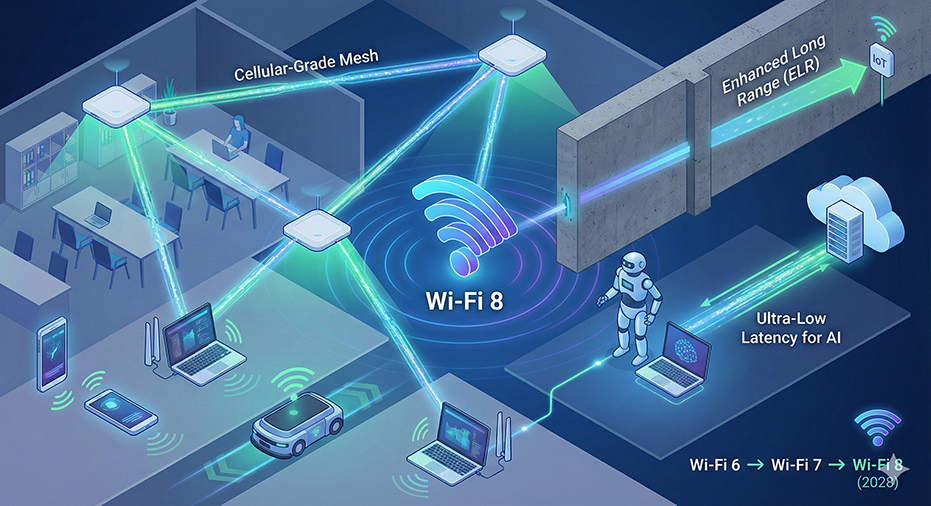
According to MediaTek, whose Wi-Fi 8 SoCs have been sampling since late 2025, the new standard maintains the same peak PHY data rates as Wi-Fi 7. However, the real magic lies in features like Enhanced Long Range (ELR) and Distributed Resource Units (DRU). These technologies aim to deliver up to 2x higher throughput and a 7x reduction in latency where it matters most: in real-world environments with obstacles and interference.
This evolution places a premium on high-quality Terminal Antenna designs. Whether for smartphones, laptops, or industrial IoT devices, the antenna must be capable of handling unequal modulation and varying MCS levels effectively. A well-engineered Terminal antenna will be the key to unlocking the "better uplink performance" that Wi-Fi 8 promises for AI applications.
"Cellular-Grade" Mesh Networking
One of the most exciting prospects of Wi-Fi 8 is its approach to mesh networking. The new standard introduces multi-AP coordination, bringing a level of seamlessness previously reserved for cellular networks (like 4G/5G).
This "make before break" roaming capability means that Ceiling antenna and Wall mount antenna deployments in offices and large venues must be more precise than ever. The coordination between Access Points (APs) relies on robust signal integrity. As a result, we expect a surge in demand for high-performance MIMO ceiling antenna and Dual-polarized ceiling antenna solutions that can support these complex, synchronized interactions between multiple APs and clients.
Bridging the Gap: Wi-Fi 6, Wi-Fi 7, and Beyond
While Wi-Fi 8 certification is targeted for early 2028, the industry is currently in the midst of the Wi-Fi 7 transition. The innovations we see today in WiFi7 antenna technology—such as wider channel support and multi-link operation—are laying the groundwork for Wi-Fi 8.
For businesses upgrading their infrastructure now, investing in premium WiFi6 antenna and WiFi7 antenna systems is crucial. High-gain WiFi horn antenna and Omni antenna solutions available today can already significantly improve coverage in the "challenging conditions" that Wi-Fi 8 aims to address via software.
Furthermore, for fixed wireless access, CPE antenna and Router antenna designs are evolving. The future will likely see WiFi Wimax Antenna technologies merging more closely with cellular standards, creating a hybrid connectivity landscape.
Your Partner for Future-Proof Wireless Solutions
As the market prepares for devices hitting the shelves in 2028, BBT Antennas remains at the forefront of RF innovation. From whip antenna units for basic routers to complex embedded PCB antenna solutions for next-gen IoT, we cover the entire spectrum.
We understand that whether it's a WiFi Wimax Antenna for long-range backhaul or a compact 2.4G antenna for smart home devices, the quality of manufacturing determines the quality of the connection.
As MediaTek and others push the boundaries of what protocols can do, we are here to ensure your hardware can keep up.