
Selecting the right drone antenna directly affects communication range, data throughput, and mission reliability. For commercial and industrial UAV systems, the choice involves matching frequency bands (2.4 GHz, 5.8 GHz, or dual-band), antenna type, gain, and environmental requirements to your specific project. BBT ANTENNAS supplies standard omni antennas and custom OEM/ODM solutions for UAV communication applications.
Last updated: August 2026
Why Antenna Selection Matters for UAV Communication
In any UAV communication system, the antenna is the single component that determines whether a radio link stays connected or drops out. A poorly matched drone antenna cuts range, degrades video quality, and increases packet loss during critical flight phases.
For B2B projects involving inspection drones, mapping platforms, agricultural sprayers, or delivery vehicles, antenna failures create direct financial loss: missed survey data, aborted missions, or damaged equipment. The stakes rise further when multiple drones share spectrum in the same operating area and interference management depends on antenna pattern control.
A drone communication antenna must perform under conditions that fixed-installation antennas rarely face: vibration, rapid orientation changes, temperature swings, and continuous exposure to rain or dust. Selecting the right UAV antenna means accounting for all of these factors before the first flight test, not after.
Key Frequency Bands for Drone Antennas
2.4 GHz Band
The 2.4 GHz band (2400-2500 MHz) remains the standard for drone control and telemetry links. Its longer wavelength provides better signal penetration through obstacles and maintains stable connections at extended distances. Most regulatory environments worldwide permit 2.4 GHz operation for unmanned systems, making it the default choice for command-and-control channels.
Typical applications include flight controller links, real-time telemetry data streams, and low-to-medium bandwidth payload control. When your UAV project requires a reliable primary control link with solid range, a 2.4 GHz drone antenna is the starting point.
5.8 GHz Band
The 5.8 GHz band (5150-5850 MHz) offers wider channel bandwidth, making it the preferred choice for high-definition video transmission and high-speed data links. With more available spectrum, a 5.8 GHz drone antenna supports the throughput needed for real-time HD or 4K video downlinks from inspection cameras and mapping sensors.
The tradeoff: 5.8 GHz signals attenuate faster over distance and through obstacles compared to 2.4 GHz. This makes 5.8 GHz antennas a better fit for video and data channels where range requirements are moderate, or where directional antennas can compensate with higher gain.
Dual-Band (2.4/5.8 GHz) Solutions
Many commercial UAV systems run both bands at once: 2.4 GHz for control and 5.8 GHz for video. A dual-band antenna covering 2400-2500 MHz and 5150-5850 MHz consolidates both links into a single antenna element, reducing weight, mounting complexity, and airframe integration effort.
BBT ANTENNAS produces dual-band omni antennas specifically listed for drone communication systems in the 2.4G/5.8G product line. These antennas cover both frequency ranges with calibrated gain and VSWR performance across each band.
The table below compares the two primary frequency bands used in UAV communication:
| Parameter | 2.4 GHz | 5.8 GHz |
|---|---|---|
| Frequency range | 2400-2500 MHz | 5150-5850 MHz |
| Typical role in UAV systems | Control, telemetry | Video, high-speed data |
| Signal propagation | Better obstacle penetration, longer range | Higher bandwidth capacity, faster attenuation |
| Regulatory access | Widely permitted globally | Varies by region |
| Best paired with | Omni antenna for broad coverage | Directional antenna for focused links |
Antenna Types for UAV Systems
Two antenna categories cover most drone communication applications:
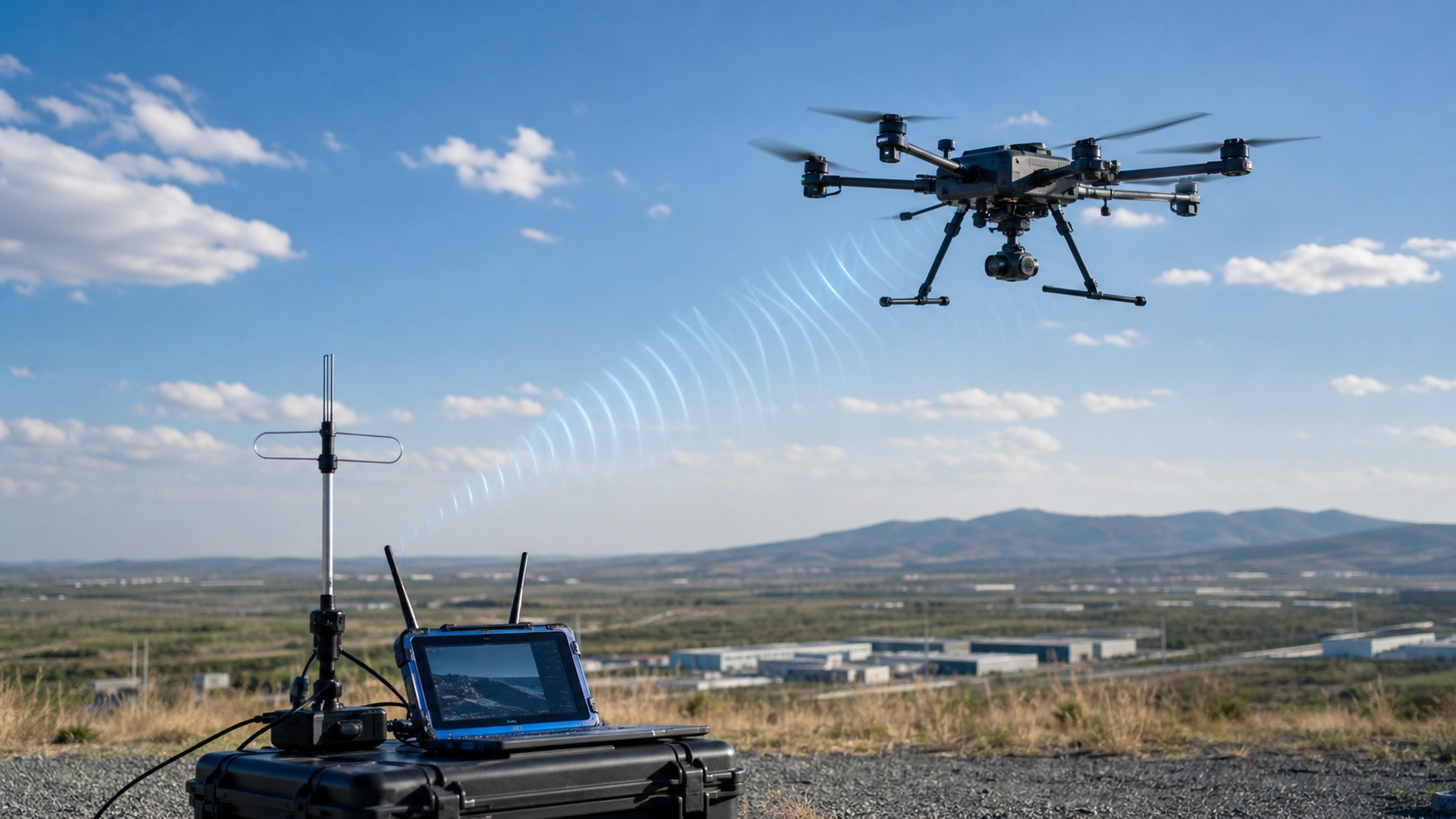
Omnidirectional antennas radiate signal in all directions around the horizontal plane. On a ground station, an omni antenna maintains the communication link regardless of which direction the drone flies. On the drone itself, an omni antenna keeps the downlink active through banking turns and orientation changes. For ground stations that serve multiple drones or track unpredictable flight paths, omnidirectional antennas are the practical default.
Directional antennas focus energy toward a specific direction, delivering higher gain and longer range along that axis. On a ground station, a directional antenna paired with a tracking mount can extend communication distance well beyond what an omni antenna achieves at the same power level. Directional antennas also serve fixed-point relay links between ground stations or between a base and a remote takeoff position.
The BBT ANTENNAS 2025 catalog lists 2.4G/5.8G omni antennas with "Drone communication systems" as a designated application. These vertically polarized omni antennas are designed for ground-station deployment and point-to-point wireless transmission in UAV projects.
Technical Parameters That Matter
When evaluating a drone antenna for a commercial UAV project, focus on these specifications:
- Gain (dBi): Higher gain extends link range but narrows the beam. Ground-station omni antennas for UAV use typically range from 3 to 8 dBi depending on coverage vs. range priorities.
- Beam width: Expressed in degrees for horizontal and vertical planes. A 360-degree horizontal beam width indicates omnidirectional coverage. Narrower vertical beam widths (15-50 degrees) concentrate energy toward the horizon and reduce ground-bounce interference.
- VSWR: Measures impedance match between antenna and feedline. Lower VSWR (closer to 1.0) means more efficient power transfer. For UAV applications, VSWR at or below 1.8 is the standard threshold.
- Polarization: Most UAV communication antennas use vertical polarization. Matching polarization between ground station and airborne antennas is necessary for maintaining signal strength.
- Connector: N-type connectors are common for ground-station and external-mount drone antennas due to their weather resistance and solid RF performance.
- Size and weight: Airborne antennas must meet strict weight and form-factor constraints. Ground-station antennas have more flexibility but still need to fit existing mast or tripod mounts.
The table below shows specifications for three BBT ANTENNAS models listed for drone communication systems in the 2025 official catalog:
| Specification | BBT-2458WA0506V | BBT-2458FG0608V | BBT-5158FG08V |
|---|---|---|---|
| Frequency (MHz) | 2400-2500 / 5150-5850 | 2400-2500 / 5150-5850 | 5150-5850 |
| Polarization | V | V | V |
| Gain (dBi) | 3 / 6 | 6 / 8 | 8 |
| Beam Width (°) | 360 / 50; 360 / 40 | 360 / 25; 360 / 16 | 360 / 15 |
| VSWR | ≤1.8 | ≤1.7 | ≤1.5 |
| Connector | N Male | N Male | N Male |
| Dimension (mm) | Φ20*175 | Φ20*280 | Φ20*370 |
These models range from a compact dual-band option (Φ20 x 175 mm, 3/6 dBi) to higher-gain configurations (Φ20 x 370 mm, 8 dBi single-band), giving project teams a direct starting point for specification matching. Browse the full WiFi 7 / WiMAX antenna product line for additional models and datasheets.
Standard Products vs Custom Antenna Solutions
When standard products fit: If your UAV project operates on 2.4 GHz, 5.8 GHz, or both, and requires standard omnidirectional coverage with N-type connectors, existing catalog models can ship quickly with known specifications. Standard products work well for prototype builds, pilot programs, and applications where specifications align with available models.
When you need custom development: Projects with non-standard frequency combinations, specialized form factors (flush-mount, conformal, or integrated into airframe structures), weight restrictions below catalog-product levels, ruggedized environmental ratings, or private-label OEM/ODM requirements call for a custom approach.
BBT ANTENNAS operates as both a product supplier and a drone antenna manufacturer with full custom capabilities. The company maintains a 30,000-square-meter R&D and production facility, holds ISO 9001:2015 and ISO 14001:2015 certifications, and employs dedicated RF, microwave, simulation, and structural engineering teams. For OEM projects, BBT provides custom design, tooling, prototyping, four-stage quality inspection, and volume production under the buyer's brand. Learn more about custom and OEM capabilities on the custom antenna manufacturer page.
Drone Antenna FAQ
What frequency is best for drone communication antennas?
It depends on the link type. Use 2.4 GHz (2400-2500 MHz) for control and telemetry links where range and obstacle penetration matter most. Use 5.8 GHz (5150-5850 MHz) for high-bandwidth video and data transmission. Many commercial UAV systems combine both bands, using dual-band antennas to handle control and video on a single element.
Can I use a single dual-band antenna for both control and video on a UAV?
Yes. Dual-band antennas covering 2400-2500 MHz and 5150-5850 MHz support simultaneous control (2.4 GHz) and video (5.8 GHz) links from one antenna. This approach reduces airframe weight and simplifies integration. BBT ANTENNAS produces dual-band omni models specifically designed for drone communication systems.
What antenna gain do I need for long-range drone communication?
For omnidirectional ground-station antennas, 3 to 6 dBi suits most medium-range UAV operations. For extended range, 8+ dBi omni or directional antennas provide stronger signals at the cost of narrower vertical beam width. The right gain depends on your target range, acceptable beam coverage, and local regulatory power limits.
What is the difference between omni and directional antennas for UAV ground stations?
Omni antennas provide 360-degree horizontal coverage, maintaining links with drones flying in any direction without repositioning. Directional antennas focus energy toward a specific sector, delivering higher gain and longer range but requiring antenna tracking or manual adjustment. Most multi-mission ground stations start with omni antennas for operational flexibility.
Does BBT ANTENNAS provide custom drone antennas for OEM projects?
Yes. BBT ANTENNAS operates a 30,000-square-meter facility with RF, microwave, and structural engineering teams dedicated to custom antenna development. Services include frequency tuning, form-factor design, prototyping, testing, private-label manufacturing, and volume production under the buyer's brand. Visit the custom antenna manufacturer page to start a project discussion.
How do I request a sample or quotation for UAV antennas?
Request a sample or quotation through our inquiry page, or contact our sales team directly. For standard catalog products, we can provide specifications and pricing quickly. For custom requirements, our engineering team evaluates your project and then sends you a quotation.
Ready to source drone antennas for your next UAV project?