
Livestock RFID projects need UHF panel antennas that match the chute width, tag orientation, and environment at each identification point. BBT ANTENNAS manufactures 902-928 MHz circular-polarized panels in 5, 9, and 10 dBi configurations, with samples, custom design, and volume supply for integrators and OEM partners.
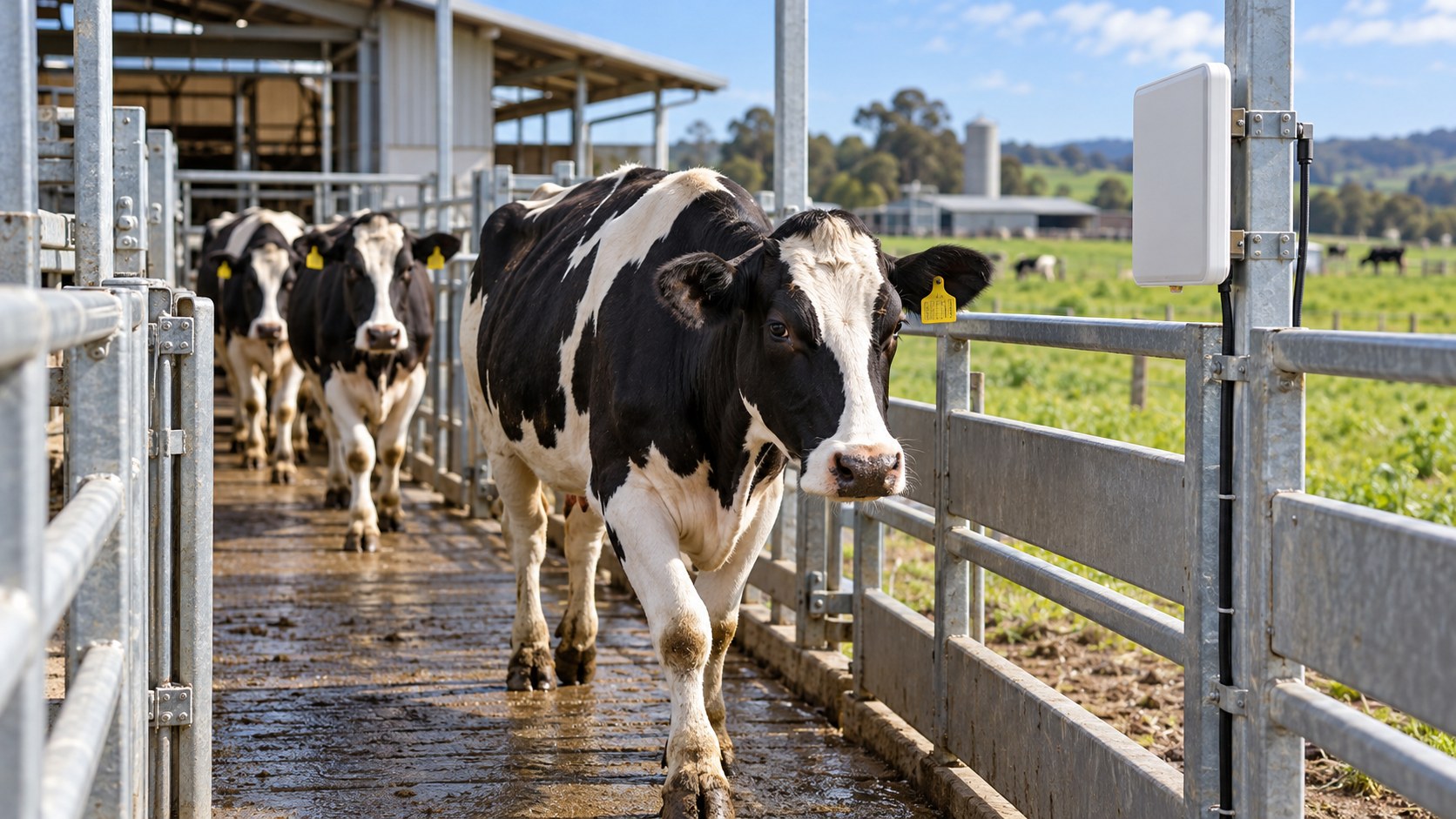
Why UHF RFID Is Replacing LF for Livestock Identification
Most national livestock identification programs started with low-frequency (134.2 kHz) ear tags. An LF tag must be held within a few centimeters of a handheld reader. That works for a vet examining one animal at a time, but it cannot keep up with commercial operations that move hundreds of cattle through chutes, gates, and loading docks every hour.
UHF RFID (860-928 MHz) covers more ground. A fixed UHF reader paired with a panel antenna can capture ear tags at distances from 0.5 m to over 4 m, depending on antenna gain and reader power. ScotEID field trials in the UK measured a fixed reader at full power reading UHF ear tags at 4.5 m; reducing power to 50% shortened the range to 0.5 m (Impinj Speedway 420, ScotEID report, September 2023). That kind of adjustability lets integrators define a precise identification zone for each station.
Regulators are following the same direction. The UK permits UHF transponders for official bovine identification under ISO 18000-6c (GOV.UK, August 2021). India's Bharat Pashudhan program has built a national digital livestock registry that tracks hundreds of millions of animals (Press Information Bureau, December 2025). The USDA published an interim UHF tag data standard alongside the established LF protocol.
For equipment suppliers and system integrators, the antenna is the component that shapes the read zone. Gain, beam width, polarization, and mounting position determine whether a system reads one animal cleanly or picks up tags from the next pen.
How to Choose the Right RFID Antenna for Your Livestock Setup
The antenna focuses RF energy into the area where tagged animals pass. Three common identification setups call for different antenna configurations.
How the antenna shapes a chute read zone
- Panel antenna
- Read zone
- Ear tag
Single-File Chute and Weighing Station
Passage width: 0.8 to 1.2 m. Animals move through one at a time. The priority is reading only the animal inside the station while rejecting tags from animals waiting behind it.
A 9 or 10 dBi panel antenna with a narrower beam, mounted 0.5 to 1.5 m from the tag path, concentrates energy on the target zone. The BBT-RFID09C09 (9 dBi, 60° x 55° beam) fits most chute installations. For longer read ranges or vehicle-mounted readers approaching cattle, the BBT-RFID09C10 (10 dBi, 45° x 60° beam) provides tighter coverage at greater distance.
ScotEID trials confirmed that operators can tune reader power downward to limit the detection boundary and prevent cross-reads from adjacent pens.
Wide Gate and Group Sorting Pen
Passage width: 2 to 4 m. Multiple animals pass together. The system must capture every tag in the group, regardless of how each ear tag is angled during movement.
A lower-gain, wide-beam antenna covers this scenario. The BBT-RFID09C05-145 (5 dBi, 80° x 70° beam) illuminates a broad area from a compact 145 x 145 mm housing. Mounting two units on opposite sides of the gate doubles coverage. Its SMA connector and integrated LMR200 cable simplify field wiring for portable or temporary setups.
Loading Dock and Transport Vehicle
Animals enter or exit trucks in outdoor environments. Rain, dust, and temperature swings from -40 °C to +60 °C are routine. Variable tag distances add complexity.
The BBT-RFID09C10 handles these conditions. Its 10 dBi gain reaches tags at longer distances, the ABS radome carries an IP67 rating, and the wide operating temperature range suits unheated docks and open yards. The N-Type Female connector supports standard low-loss coaxial runs to the reader cabinet.
UHF RFID Antennas for Livestock Projects

5 dBi Wide-Beam RFID Panel
BBT-RFID09C05-145
80° x 70° beam, 145 x 145 mm, SMA male, IP67. Compact gate-side antenna for group tag capture.
View Specs
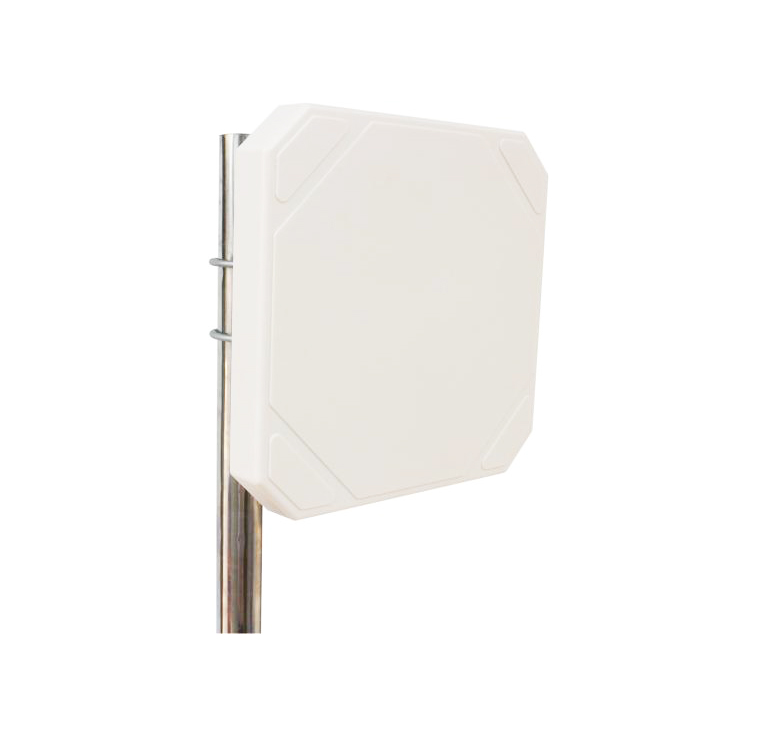
9 dBi Mid-Range RFID Panel
BBT-RFID09C09
60° x 55° beam, 255 x 255 mm, N-Type, IP67. Focused chute and weighing station antenna.
View Specs
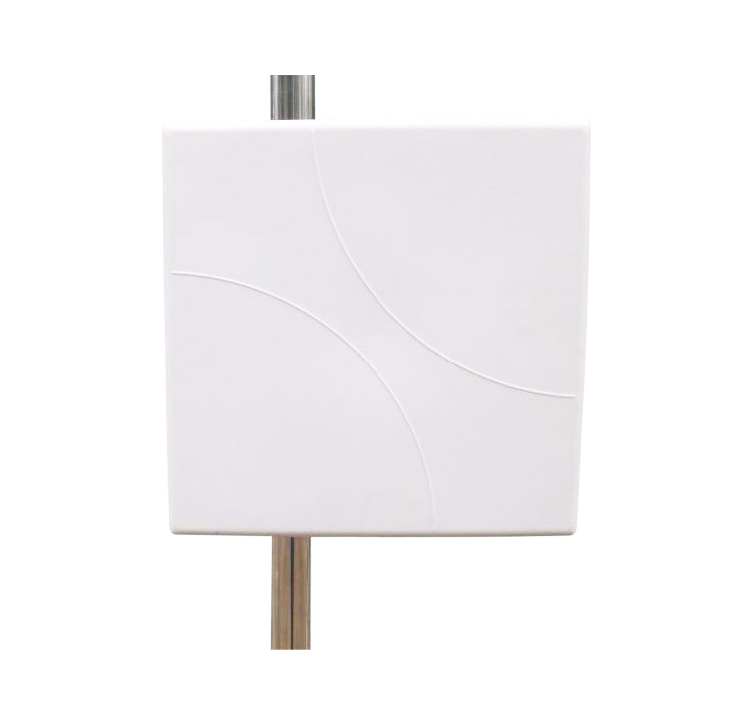
10 dBi High-Gain RFID Panel
BBT-RFID09C10
45° x 60° beam, 385 x 385 mm, N-Type, IP67. Long-range dock and transport antenna rated to -40 °C.
View Specs
Need a custom frequency, connector, or branding? BBT ANTENNAS provides OEM/ODM manufacturing for overseas antenna brands.
Need antenna samples or project configuration support?
Antenna Comparison: 5 dBi vs. 9 dBi vs. 10 dBi
| Parameter | BBT-RFID09C05-145 | BBT-RFID09C09 | BBT-RFID09C10 |
|---|---|---|---|
| Gain | 5 dBi | 9 dBi | 10 dBi |
| Beam Width (H x E) | 80° x 70° | 60° x 55° | 45° x 60° |
| Frequency | 902-928 MHz | 902-928 MHz | 902-928 MHz |
| Polarization | RHCP | RHCP | RHCP |
| VSWR | ≤1.3 | ≤1.3 | ≤1.3 |
| Connector | SMA male | N-Type Female | N-Type Female |
| Dimensions (mm) | 145 x 145 | 255 x 255 x 30 | 385 x 385 x 30 |
| Temp Range | -25 °C to +65 °C | -40 °C to +60 °C | -40 °C to +60 °C |
| Best For | Wide gates, group sorting, compact spaces | Chutes, weighing stations, aisle readers | Loading docks, long range, transport |
All three models use right-hand circular polarization (RHCP), which reads ear tags at any angle. All share VSWR ≤1.3 and DC-grounded lightning protection. EU-standard variants (860-868 MHz) are available on request.
Frequently Asked Questions
Why is circular polarization recommended for livestock RFID?
Ear tags on live animals rotate, twist, and tilt as the animal moves. A circularly polarized (RHCP) antenna reads tags at any angle, while a linearly polarized antenna only reads reliably when the tag aligns with the antenna's polarization axis. For livestock applications where tag orientation is unpredictable, RHCP keeps read rates high across the entire detection zone.
Can UHF RFID accidentally read an animal in the next pen?
Yes, if the antenna gain is too high or reader power is set too wide for the station layout. The fix is antenna selection and power tuning: use a narrower-beam antenna (9 or 10 dBi) aimed at the target zone, and reduce reader power until the read boundary matches the station area. ScotEID field trials showed that cutting fixed-reader power from 100% to 50% shortened the read distance from 4.5 m to 0.5 m.
Do these antennas work with both US (FCC) and EU (ETSI) frequency bands?
The standard models operate at 902-928 MHz (FCC). BBT ANTENNAS produces EU-standard variants at 860-868 MHz on request. Share your deployment region when you request samples, and we will supply the antenna version that matches your reader and local band.
Does BBT ANTENNAS offer OEM branding or custom specifications?
Yes. BBT ANTENNAS is a direct antenna manufacturer with over 30 years of production experience and full OEM/ODM capability. We modify operating frequency, connector type, cable length, radome color, and branding for private-label programs. Contact us to discuss your specifications.
How do I get antenna samples for my livestock RFID project?
Contact our sales team with your project region, reader model, passage layout, and quantity estimate. We ship evaluation samples and provide antenna configuration guidance so you can validate read performance in your actual environment before placing volume orders.
Tell us about your livestock RFID project. We will recommend the right antenna configuration, ship evaluation samples, and support your rollout from prototype to production.
Get a Quote for Your Livestock Project