
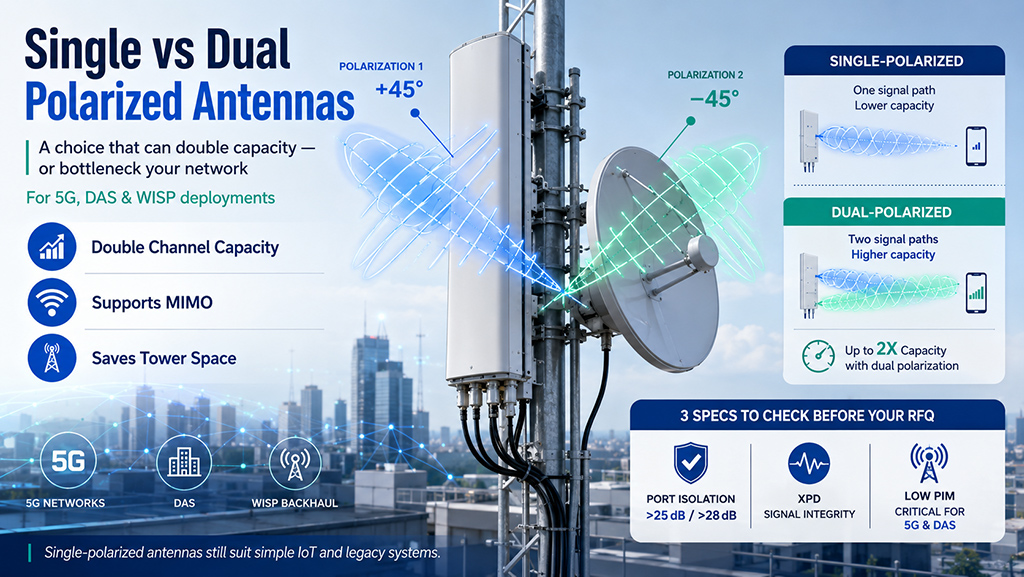
A dual-polarized antenna transmits and receives wireless signals on two orthogonal planes simultaneously, typically using ±45° slant or vertical and horizontal (V/H) alignment. This design doubles channel capacity, reduces multipath fading, and supports MIMO applications without increasing the physical footprint of the installation.
Single Polarized vs Dual Polarized Antenna: Which Fits Your Project?
When planning a wireless network, you must choose between single and dual polarization based on capacity requirements and space constraints.
| Feature | Single Polarized Antenna | Dual Polarized Antenna |
|---|---|---|
| Signal Planes | One (Vertical or Horizontal) | Two Orthogonal (V/H or ±45°) |
| Capacity | Standard | Double (supports MIMO) |
| Space Efficiency | Requires two physical antennas for diversity | One antenna enclosure handles two streams |
| Best For | Legacy systems, simple point-to-point links, IoT | 5G, DAS, WISP, high-capacity wireless backhaul |
Selecting the Right Dual-Polarized Antenna Type for Your Application
The physical form factor of the antenna determines how it directs RF energy. Match the antenna type to your specific installation environment.
5G and Cellular Networks (Sector and Panel Antennas)
Base station and cell tower applications rely on ±45° slant polarization. This configuration reduces interference from vertical objects like buildings and trees. For cellular coverage, a DAS / 5G antenna category product or a dual-polarization sector antenna provides wide horizontal beamwidths to cover designated zones effectively.
Wireless Backhaul and WISP (Dish and Parabolic Antennas)
Point-to-point wireless internet service provider (WISP) links require extreme distance and high throughput. A dual-polarized dish antenna offers high gain and a narrow beamwidth, focusing energy precisely at the receiving site while using V/H polarization to maximize data rates over long distances.
Industrial IoT and Remote Areas (Yagi Antennas)
For SCADA systems, remote data collection, or challenging outdoor environments, a dual-polarized Yagi antenna provides high directionality and rugged construction. These antennas maintain strong links despite harsh weather and physical obstacles.
Key Specifications to Check Before Sourcing
Evaluating the datasheet correctly prevents project delays and poor network performance. When comparing suppliers, check these critical specifications:
- Frequency Band and Gain: Verify the antenna covers your exact operating frequencies (for example, 3.3-4.2 GHz for specific 5G bands) and provides sufficient gain in dBi for your required distance.
- Port Isolation: This is the most critical metric for dual-polarized designs. High isolation (typically greater than 25dB or 28dB) ensures the two signal streams do not interfere with each other.
- Cross-Polarization Discrimination (XPD): A high XPD value means the antenna clearly separates the two orthogonal signals, which is vital for maintaining data integrity in complex RF environments.
- Low PIM (Passive Intermodulation): For 5G and DAS networks, low PIM ratings (often ≤ -150 dBc or better) are necessary to prevent self-generated interference that degrades upload speeds.
- Connector Type and Mounting: Ensure the connectors (such as N-Female or 4.3-10) match your radio equipment and that the mounting hardware withstands your expected wind loads.
Preparing Your RFQ for a Custom Antenna Manufacturer
If standard off-the-shelf models do not meet your project constraints, working directly with a custom antenna manufacturer ensures exact specification matching.
When requesting a quote for OEM/ODM private-label manufacturing, provide your required frequency bands, gain, beamwidth, port isolation, and specific environmental durability needs. BBT ANTENNAS operates a 30,000-square-meter R&D and production facility with over 200 staff and four-stage quality control. We hold ISO9001:2015 and ISO14001:2015 certifications, delivering reliable customization and manufacturing services for overseas brands and project buyers.
Frequently Asked Questions (FAQ)
What is a ±45° polarized antenna?
Is a dual-polarized antenna always a MIMO antenna?
Can I request custom frequency bands for a dual-polarized antenna?
Ready to source dual-polarized antennas for your next project? Send us your technical requirements or request our OEM/ODM capability deck today.
Request an OEM/ODM Quote