
RF Spectrum Bandwidth Explained: From LF to EHF Frequency Bands
In modern wireless communication systems, bandwidth is one of the key factors that affects data capacity, transmission speed, signal quality, and overall network performance.
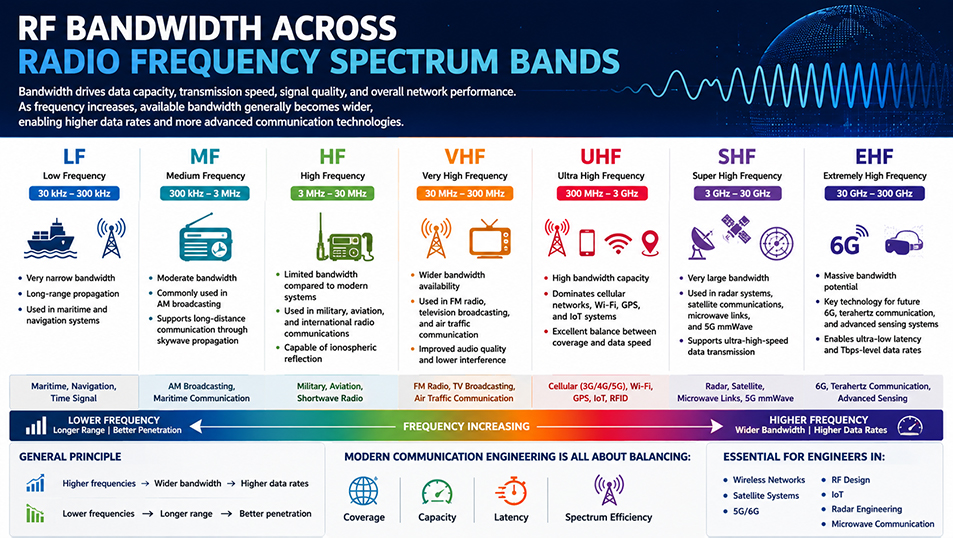
Different radio frequency bands have different bandwidth potential, propagation characteristics, and application scenarios. In general, lower frequency bands provide longer transmission range and better penetration, while higher frequency bands can support wider bandwidth and higher data rates.
However, available bandwidth is not determined by frequency alone. It also depends on spectrum allocation, communication standards, regulations, antenna design, and system requirements.
Understanding RF bandwidth across different frequency bands is important for engineers, system integrators, and buyers working with 4G, 5G, WiFi, DAS, RFID, IoT, satellite communication, radar, and microwave systems. VHF antenna
What Is Bandwidth in RF Communication?
In RF communication, bandwidth refers to the range of frequencies used by a signal or communication channel.
A wider bandwidth usually allows more information to be transmitted at the same time. This is why bandwidth is closely related to data rate and network capacity.
For example, modern 5G, WiFi 6, WiFi 7, satellite, and microwave systems often require wider bandwidth to support high-speed data transmission, low latency, and multiple connected devices.
But bandwidth alone does not determine performance. Other factors such as modulation, coding, MIMO technology, signal-to-noise ratio, antenna efficiency, and interference also affect the final communication quality.
Why Frequency Bands Matter
Radio frequency spectrum is divided into different bands, from low frequency to extremely high frequency. Each band has different advantages and limitations.
The general principle is:
Lower frequencies → Longer range and better penetration
Higher frequencies → Wider bandwidth and higher data rates
Lower frequency signals can travel longer distances and bend around obstacles more easily. They are useful for long-range communication, broadcasting, navigation, and some industrial systems.
Higher frequency signals can support wider bandwidth and faster data transmission, but they usually have shorter range and are more sensitive to blockage, rain attenuation, and installation conditions.
This is why modern wireless engineering is always a balance between:
- Coverage
- Capacity
- Latency
- Penetration
- Interference control
- Spectrum efficiency
- Antenna size and performance
RF Spectrum Bands from LF to EHF
The RF spectrum is commonly divided into the following frequency bands:
| Band | Frequency Range | Bandwidth Potential | Typical Applications |
|---|---|---|---|
| LF | 30 kHz – 300 kHz | Very narrow | Maritime, navigation |
| MF | 300 kHz – 3 MHz | Narrow to moderate | AM broadcasting, long-distance radio |
| HF | 3 MHz – 30 MHz | Limited | Aviation, military, shortwave radio |
| VHF | 30 MHz – 300 MHz | Wider | FM radio, TV, air traffic communication |
| UHF | 300 MHz – 3 GHz | High | Cellular, GPS, RFID, IoT, wireless systems |
| SHF | 3 GHz – 30 GHz | Very high | WiFi, radar, satellite, microwave links, 5G |
| EHF | 30 GHz – 300 GHz | Massive potential | mmWave, advanced sensing, future 6G research |
Each band serves different communication needs. The best frequency band depends on the required range, bandwidth, data rate, antenna size, and installation environment.
LF, MF, and HF: Long Range with Limited Bandwidth
LF, MF, and HF bands are mainly used for long-range communication, broadcasting, navigation, and special-purpose radio systems.
LF signals can travel very long distances and are useful in maritime and navigation applications. However, their available bandwidth is very narrow, so they are not suitable for high-speed data transmission.
MF is commonly used in AM broadcasting. It can support long-distance communication, especially through groundwave and skywave propagation.
HF is widely used in aviation, military, shortwave broadcasting, and international radio communication. One important feature of HF is ionospheric reflection, which allows signals to travel beyond the horizon.
These low and middle frequency bands are valuable for coverage, but their limited bandwidth makes them less suitable for modern high-capacity wireless networks.
VHF and UHF: Balance Between Coverage and Capacity
VHF and UHF bands provide a better balance between range, penetration, antenna size, and bandwidth.
VHF is used in FM radio, television broadcasting, marine communication, air traffic communication, and professional radio systems. It provides good coverage and relatively stable propagation.
UHF is one of the most important frequency ranges in modern wireless communication. It is widely used in cellular networks, GPS, UHF RFID, IoT systems, public safety communication, and many wireless devices.
Compared with lower frequency bands, UHF offers higher bandwidth capacity while still maintaining practical coverage performance. This makes it suitable for many commercial and industrial wireless applications.
For antenna design, VHF and UHF antennas must balance gain, radiation pattern, size, efficiency, and installation requirements.
SHF and EHF: High Bandwidth for Modern Wireless Systems
SHF and EHF bands support much wider bandwidth and are widely used in high-speed communication systems.
SHF covers 3 GHz to 30 GHz and is used in WiFi, radar, satellite communication, microwave links, and many 5G applications. This band is important for systems that require high data throughput and directional communication.
EHF covers 30 GHz to 300 GHz and includes millimeter-wave frequencies. These frequencies offer massive bandwidth potential and are important for advanced sensing, high-capacity wireless links, and future 6G research.
However, higher frequency systems require careful engineering. Signals at SHF and EHF are more affected by path loss, obstacles, rain, atmospheric absorption, and antenna alignment.
This is why high-frequency systems often use directional antennas, such as panel antennas, horn antennas, dish antennas, phased array antennas, and other high-gain antenna solutions.
How Bandwidth Affects Antenna Design
Bandwidth is not only a communication system parameter. It is also a key consideration in antenna design.
An antenna must be designed to operate efficiently across the required frequency range. For wideband systems, the antenna should maintain stable performance across the whole operating band.
Important antenna parameters include:
- Frequency range
- Gain
- VSWR
- Radiation pattern
- Beamwidth
- Polarization
- Efficiency
- Connector type
- Mechanical structure
- Environmental protection
For example, a 5G antenna may need to support multiple frequency bands. A WiFi antenna may need to operate across 2.4 GHz, 5 GHz, and 6 GHz bands. An RFID antenna must be optimized for the required reading range and reading zone. A DAS antenna must provide stable indoor coverage across supported cellular bands.
The wider the operating bandwidth, the more challenging the antenna design becomes.
Application Examples Across RF Bands
Different frequency bands are used in different communication systems.
Cellular and 5G Networks
Cellular systems use a wide range of bands, from sub-GHz coverage bands to mid-band and high-band 5G frequencies. Lower bands improve coverage, while higher bands improve capacity.
WiFi and Wireless Data Systems
WiFi commonly operates in 2.4 GHz, 5 GHz, and 6 GHz bands. Higher frequency WiFi bands can provide wider bandwidth and faster speeds, but coverage distance may be shorter.
DAS Indoor Coverage
DAS antennas are used to improve indoor cellular coverage in buildings, airports, hotels, hospitals, stadiums, tunnels, and parking areas. The antenna must support the required cellular bands and provide suitable coverage.
RFID and IoT Systems
RFID and IoT applications may use HF, UHF, or other wireless bands depending on reading distance, data requirements, and environment. Antenna gain, polarization, and beamwidth are important for system reliability.
Satellite, Radar, and Microwave Links
These systems often use SHF and EHF bands because they require directional transmission, high capacity, and precise signal control.
Choosing the Right Antenna for Your Frequency Band
When choosing an antenna, frequency range is the first requirement, but it is not the only one.
Engineers and buyers should also consider:
- Required bandwidth
- Coverage distance
- Data capacity
- Antenna gain
- Radiation pattern
- Indoor or outdoor installation
- Polarization
- VSWR and efficiency
- Connector and cable type
- Waterproof and mechanical design
- Customization requirements
A low-frequency antenna may be larger but better for long-range coverage. A high-frequency antenna may be smaller and support higher data rates, but it requires more precise design and installation.
The right antenna should match the communication system, working environment, and performance target.
BBT ANTENNAS RF Antenna Solutions
BBT ANTENNAS provides antenna solutions for a wide range of wireless communication applications, including 4G LTE, 5G, WiFi, DAS, RFID, IoT, LoRa, VHF/UHF, GNSS, satellite, microwave, and customized RF systems.
Our antenna products are designed for different applications, such as base stations, indoor distributed antenna systems, outdoor wireless coverage, RFID security, public transportation, smart city networks, industrial IoT, and customized communication projects.
By understanding RF bandwidth, frequency bands, propagation characteristics, and antenna performance, customers can select better antenna solutions for real-world communication systems.
Conclusion
Bandwidth across RF spectrum bands plays an important role in wireless communication performance.
Lower frequency bands usually provide longer range and better penetration, but their bandwidth is limited. Higher frequency bands can support wider bandwidth and higher data rates, but they require more careful design because of shorter range, higher path loss, and environmental sensitivity.
Modern communication engineering is about finding the right balance between coverage, capacity, latency, spectrum efficiency, and antenna performance.
Whether you are working with 4G, 5G, WiFi, DAS, RFID, IoT, satellite, radar, or microwave communication systems, understanding RF bandwidth and frequency band characteristics will help you choose the right antenna solution.
BBT ANTENNAS offers reliable antenna products and customized RF antenna solutions for different wireless communication applications. Contact us to discuss your project requirements.
FAQ
What is RF bandwidth?
RF bandwidth is the range of frequencies used by a radio signal or communication channel. Wider bandwidth usually allows higher data capacity.
Why do higher frequencies usually support wider bandwidth?
Higher frequency bands often provide more available spectrum, which allows wider channels and higher data rates. However, actual available bandwidth depends on regulations, standards, and system design.
Which RF band is best for long-range communication?
Lower frequency bands such as LF, MF, and HF are generally better for long-range communication because they have better propagation characteristics.
Which frequency bands are used for 5G and WiFi?
5G can use low-band, mid-band, and high-band frequencies. WiFi commonly uses 2.4 GHz, 5 GHz, and 6 GHz bands.
How does bandwidth affect antenna design?
Antenna bandwidth determines the frequency range over which the antenna can operate effectively. Wideband antennas must maintain stable gain, VSWR, radiation pattern, and efficiency across the required frequency range.