

The way we make phone calls has fundamentally changed. Today, voice traffic is largely transmitted as digital data packets over various internet protocols. While terms like VoLTE, VoIP, and VoWiFi are often used interchangeably by consumers, they represent distinct technologies with different network requirements. DAS Antennas
For network operators, system integrators, and enterprise IT planners, understanding the differences between these protocols is only the first step. The real challenge lies in building the physical RF (Radio Frequency) infrastructure to support them. Regardless of the software protocol, seamless communication ultimately depends on high-quality transmission hardware.
Let’s break down VoLTE, VoIP, and VoWiFi, and explore the essential antenna infrastructure required to keep these modern voice networks stable.
1. VoLTE (Voice over LTE) & Macro Network Coverage
- How it works: VoLTE routes voice calls over the 4G LTE or 5G mobile data network rather than legacy 2G or 3G voice circuits. The network treats voice data as highly prioritized packets, resulting in High-Definition (HD) voice quality, faster call setup times, and the ability for users to browse the internet seamlessly while on a call.
- The Infrastructure Challenge: Because VoLTE does not fall back to 2G/3G networks, a dropped LTE signal means a dropped call. Maintaining continuous, overlapping macro-network coverage is critical.
- The Antenna Solution: To support carrier-grade VoLTE performance, telecommunications providers rely on high-performance [4G/5G base station antennas]. These antennas must offer precise electrical downtilt, high gain, and excellent PIM (Passive Intermodulation) suppression to minimize interference. Robust base station antennas ensure that as a user moves from one cell tower's sector to another, the VoLTE packet handovers happen smoothly without jitter or call drops.
2. VoIP (Voice over IP) & Reliable Data Transmission
- How it works: VoIP encompasses any voice or video call routed over standard internet connections (Wi-Fi, cellular data, or broadband) using third-party applications like Zoom, Microsoft Teams, or WhatsApp. Unlike VoLTE, VoIP does not require a SIM card or a traditional phone number—only a user account and an internet connection.
- The Infrastructure Challenge: VoIP is highly sensitive to network latency and packet loss. In crowded enterprise campuses, factories, or public venues, overloaded or poorly distributed wireless networks can render VoIP communications unusable.
- The Antenna Solution: To guarantee smooth VoIP performance in high-density environments, deploying industrial-grade [WiFi coverage antennas] is essential. Directional and omnidirectional Wi-Fi antennas with optimized radiation patterns help eliminate co-channel interference and extend range. Whether it's for an office ceiling or an outdoor campus, the right Wi-Fi antenna infrastructure ensures that VoIP data packets are transmitted with minimal delay.
3. VoWiFi (Wi-Fi Calling) & Solving Indoor Dead Zones
- How it works: VoWiFi (often marketed as Wi-Fi Calling) is a carrier-provided service. When a mobile phone enters an area with a weak cellular signal—such as a deep basement, a heavily insulated building, or a rural hotel—the phone automatically routes the regular cellular call over an available Wi-Fi network. It uses the phone's native dialer and the user's existing SIM profile.
- The Infrastructure Challenge: Modern building materials (like Low-E glass, concrete, and steel) severely block macro cellular signals, creating indoor dead zones. While VoWiFi is a great software workaround for end-users, relying solely on random Wi-Fi routers is not a permanent fix for large-scale commercial buildings or hospitals.
- The Antenna Solution: To comprehensively solve indoor signal blockage, network engineers deploy Active or Passive Distributed Antenna Systems (DAS). By strategically installing [DAS antennas / Indoor distribution antennas] throughout a building, facility managers can distribute both cellular (4G/5G) and Wi-Fi signals uniformly across every floor and corridor. This guarantees that whether a device is utilizing VoLTE or falling back to VoWiFi, the underlying signal strength remains flawless.
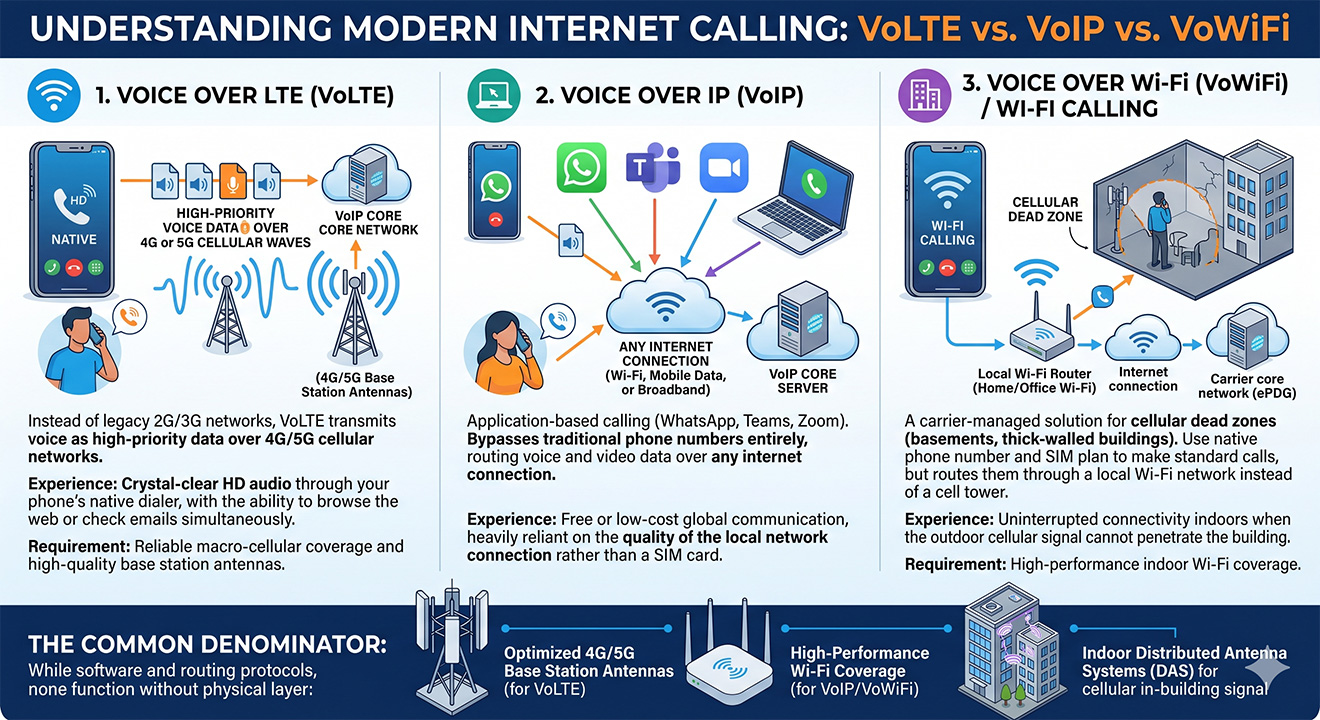
Quick Comparison: Technology & Infrastructure Requirements
| Technology | Network Protocol | Needs SIM? | Example Use Case | Key Infrastructure Requirement |
| VoLTE | 4G/5G Mobile Data | Yes | Native phone call on the street | 4G/5G base station antennas for macro coverage. |
| VoIP | Any Internet (Wi-Fi/Cellular/LAN) | No | WhatsApp/Zoom call in a cafe | WiFi coverage antennas for low-latency local networks. |
| VoWiFi | Wi-Fi (Carrier-managed) | Yes | Native phone call in a basement | DAS / Indoor distribution antennas to eliminate dead zones. |
Build a Stronger Network with the Right Hardware
Whether you are an ISP expanding your 5G footprint, or an integrator designing an enterprise communication system, the underlying RF hardware dictates the user experience.
As a professional telecommunication antenna manufacturer, BBT Antennas specializes in the design and production of high-performance RF solutions, including 4G/5G base station antennas, DAS antennas, WiFi coverage antennas, and RFID antennas.
[Contact us today] or [Browse our catalog] to find the exact antenna specifications required to optimize your network infrastructure and keep your communications crystal clear.